
CIVIL NUCLEAR
Fire in Chernobyl zone, Kiev says radiation levels safe
by Staff Writers
Kiev (AFP) June 5, 2018

Ukrainian authorities on Tuesday said a bushfire had broken out in the exclusion zone around Chernobyl, scene of the world's worst nuclear accident in 1986, but radiation levels remained within safe limits.

"Radiation levels have not risen either inside the exclusion zone or in adjoining areas," the zone's administration said in a statement.

Prime Minister Volodymyr Groysman wrote on Facebook that "radiation levels are safe. In Kiev and in Chernobyl itself including at the Chernobyl power station site, they are significantly below the acceptable limits. So there's no need to worry."

"I stress once more: the situation is fully under control," he added.

The fire broken out in dry grass on Tuesday morning in the area of high radiation less than 10 kilometres (6 miles) from the power station and later spread over some 10 hectares (25 acres) of woodland, the state emergency service said in statements.

It published photographs of smoke billowing from woodland and flames spreading along the ground.

The state nuclear industry regulator said nothing untoward had taken place inside the former nuclear power station, which is not at risk from the flames.

More than 130 firefighters were battling the fire as well as two planes and a helicopter which dumped water on the fire, the state emergency service said, adding that the wind was not blowing towards the capital Kiev.

Bushfires occur regularly in the woods and grassland around the power station. In 2015 a forest fire burned for four days.

Chernobyl's Number Four reactor, which is about 100 kilometres (62 miles) north of Kiev, exploded in 1986 during testing in the worst such accident ever.

Radioactive fallout from the power station contaminated up to three-quarters of Europe, according to some estimates, with Ukraine, Russia and Belarus, all then part of the USSR, the worst-affected.

A 30 kilometres radius around the power station is still an exclusion zone where people are not allowed to live.

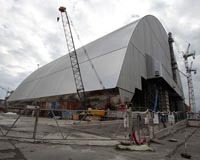
The three other reactors at Chernobyl continued to generate electricity until the power station finally closed in 2000. A giant protective dome was put in place over the fourth reactor in 2016.


Related Links
Nuclear Power News - Nuclear Science, Nuclear Technology
Powering The World in the 21st Century at Energy-Daily.com

CIVIL NUCLEAR
World's first floating nuclear barge to power Russia's Arctic oil drive
Murmansk, Russia (AFP) May 19, 2018
To meet its growing electricity needs in its drive to develop oil resources in remote Arctic regions, Russia has built a floating nuclear power station, a project that detractors deride as a "Chernobyl on ice". Built in Saint Petersburg, the Akademik Lomonosov is currently moored in Murmansk where it is being loaded with nuclear fuel before heading to eastern Siberia. On Saturday, head of state nuclear power firm Rosatom unveiled the brown-and-mustard-painted facility in the city's estuary as an ... read more

Comment using your Disqus, Facebook, Google or Twitter login.

Share this article via these popular social media networks
del.icio.usdel.icio.us DiggDigg RedditReddit GoogleGoogle

CIVIL NUCLEAR
'Deforestation-free' palm oil not as simple as it sounds

Advanced biofuels can be produced extremely efficiently, confirms industrial demonstration

Technique doubles conversion of CO2 to plastic component

Scientists have deciphered the chemical reaction mechanism critical for cleaner combustion

CIVIL NUCLEAR
UK set to smash renewable energy targets for 2020

Solar energy: Mixed anion compounds with 'fluorine' works as new photocatalytic material

How greener grids can stay lit

The blockchain project Solar DAO is to implement its first PV solar plants in Kazakhstan

CIVIL NUCLEAR
U.S. Atlantic states eye offshore wind leadership

European wind energy generation potential in a warmer world

New York to world's largest offshore wildlife aerial survey

German utility E.ON sees renewable sector growth

CIVIL NUCLEAR
Study highlights environmental cost of tearing down Vancouver's single-family homes

Bitcoin estimated to use half a percent of the world's electric energy by end of 2018

Top US court to examine India power plant complaint

Portugal's EDP rejects Chinese takeover offer

CIVIL NUCLEAR
Researchers predict materials to stabilize record-high capacity lithium-ion battery

Novel NUS-developed hydrogel invented harnesses air moisture for practical applications

Better, faster, stronger: Building batteries that don't go boom

Scientists improve ability to measure electrical properties of plasma

CIVIL NUCLEAR
EU proposes ban on straws, other single-use plastics

Kicking the car(bon) habit better for air pollution than technology revolution

Quake helps clear the blackened air over Nepal's brick kilns

Recycled electrical products lead to hazardous chemicals appearing in everyday items

CIVIL NUCLEAR
Oil prices flat as the dust settles over global trade disputes

Repsol to crunch more refinery data with Google's help

Iran sees Spain interested in its petrochemicals sector

Johan Sverdrup platform component installed

CIVIL NUCLEAR
Red Planet rover set for extreme environment workout

Opportunity Mars rover ready to study rock targets up close

New image shows exposed bedrock in Hale Crater on Mars

Embry-Riddle Student is Helping NASA Prepare for Trips to Mars