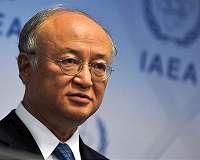
The head UN nuclear inspector said Friday that his agency is asking Saudi Arabia to agree to safeguards on nuclear material that could arrive by the end of the year for its first atomic reactor.
Satellite imagery recently emerged of the Argentine-built project on the outskirts of Riyadh, which comes amid controversy in Washington over President Donald Trump's approval of nuclear projects with the oil-rich kingdom.
But Yukiya Amano, director general of the International Atomic Energy Agency, said there was nothing secret about the reactor and that Saudi Arabia informed the Vienna-based UN body about its plans in 2014.
He said the IAEA has encouraged Saudi Arabia to put into force a comprehensive safeguards agreement, under which the agency ensures that nuclear material is not being diverted to weapons use.
Saudi Arabia in 2005 signed with the IAEA a so-called small quantities protocol, which exempts countries from inspections if they have no or minimal nuclear programs.
"We have proposed to Saudi Arabia to rescind and replace it by the full-fledged comprehensive safeguards agreement," Amano told reporters in Washington.
"They didn't say no, they didn't say yes, and they are now giving thoughts. We are waiting," he said.
"For now, they don't have the material, so there is no violation," he said.
Amano said that Saudi Arabia may bring in nuclear material "by the end of the year," although he cautioned that nuclear projects frequently get delayed.
– Start of larger nuclear program –
Saudi Arabia, the world's top crude exporter, has announced plans to spend $80 billion to build 16 nuclear reactors over the coming two decades as it diversifies energy.
The first project, being built by Argentina's state-backed nuclear company INVAP, is a so-called low power research reactor, or LPRR, that is generally used to train technicians.
"Saudi Arabia has been dragging its feet for 30 years on getting meaningful agreements in place; but the LPRR means they MUST abide by international rules," said Robert Kelley, a US Energy Department veteran and former director of nuclear inspections at the IAEA.
"Argentina is not going to supply the nuclear fuel if they don't," said Kelley, now a distinguished associate fellow at the Stockholm International Peace Research Institute.
He said that the reactor, with its small size, was insignificant by itself but was "opening a can of worms," including the prospect of the Trump administration sharing sensitive technology without review.
US Energy Secretary Rick Perry told a recent Senate hearing that his department had given the go-ahead for six applications by US companies to do nuclear work in Saudi Arabia.
The approvals come even though Saudi Arabia has not sought a so-called Section 123 Agreement to guarantee the peaceful use of nuclear technology, which is required under US law before any transfer of sensitive material.
– Rising concern over Saudis –
Saudi Arabia has come under sharp criticism in the United States over the civilian death toll in its offensive in Yemen and for the murder and dismemberment of US-based dissident writer Jamal Khashoggi.
"If you cannot trust a regime with a bone-saw, you should not trust them with nuclear weapons," Democratic Representative Brad Sherman told Secretary of State Mike Pompeo at a hearing last week.
Pompeo, in an interview Friday with CBS, signaled that the United States would ensure that Saudi Arabia does not develop nuclear weapons.
"We will not permit that to happen anywhere in the world. The president understands the threat of proliferation," he said.
Saudi Arabia's powerful crown prince, Mohammed bin Salman, has warned that the kingdom would seek nuclear weapons if its arch-rival Iran obtains one.
The Trump administration has allied itself closely with both Saudi Arabia and Israel and withdrawn from an international accord with Iran under which Tehran drastically curbed its nuclear program.
Amano, who met with Pompeo in Washington, reiterated that the IAEA has verified that Iran remains in compliance with the agreement, which is strongly backed by the Europeans.