
CIVIL NUCLEAR
International research team finds thriving wildlife populations in Chernobyl
by Staff Writers
Chernobyl, Ukraine (SPX) Oct 07, 2015


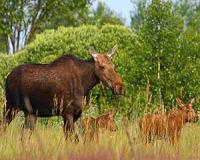
A family of moose roams free in the Chernobyl Exclusion Zone. Image courtesy Valeriy Yurko/Polessye State Radioecological Reserve. For a larger version of this image please go here.

A team of international researchers, including James Beasley, assistant professor of wildlife ecology at the University of Georgia Savannah River Ecology Laboratory and the Warnell School Forestry and Natural Resources, has discovered abundant populations of wildlife at Chernobyl, the site of the 1986 nuclear accident that released radioactive particles into the environment and forced a massive evacuation of the human population.

In the current issue of the journal Current Biology, the researchers report the site looks more like a nature preserve than a disaster zone--abundant with moose, roe deer, wild boar and wolves--nearly 30 years after the world's largest nuclear accident.

Previous studies in the 1,621-square-mile Chernobyl Exclusion Zone showed evidence of major radiation effects and significantly reduced populations of wildlife. For the first time since the Chernobyl accident, researchers have long-term census data that reveal thriving wildlife populations in the zone.

"Our data are a testament to the resiliency of wildlife when freed from direct human pressures such as habitat loss, fragmentation and persecution," said Beasley, a co-author on the study. "The multi-year data clearly show that a multitude of wildlife species are abundant throughout the zone, regardless of the level of radiation contamination."

"This doesn't mean radiation is good for wildlife, just that the effects of human habitation, including hunting, farming and forestry, are a lot worse," said Jim Smith, a professor of environmental science at the University of Portsmouth in the U.K. and the team's coordinator.

The study results show that the number of moose, roe deer, red deer and wild boar living in the zone are similar to numbers in nearby uncontaminated nature reserves in the region.

The census data on wolves in the area indicate they are seven times greater in number than those living in the nearby reserves. Aerial census data collected from 1987-1996 reveal rising numbers of moose, roe deer and wild boar in the zone.

The study's lead author, Tatiana Deryabina, a wildlife ecologist at Polessye State Radioecological Reserve in Belarus, has been "working, studying and taking photos of the wonderful wildlife in the Chernobyl area for over 20 years, and I am very pleased our work is reaching an international scientific audience."

Additional co-authors on the study include Thomas Hinton, Institute of Environmental Radioactivity, Fukushima University, Fukushima, Japan; Sergey Kuchmel, Polessye State Radioecological Reserve, Choiniki, Belarus; Liubov Nagorskaya, Academy of Sciences of Belarus, Mince, Belarus; and Adelaide Lerebours, University of Portsmouth, Portsmouth, U.K.

.


Related Links
University of Georgia
" class="highlight">Aiken SC (SPX) Oct 07, 2015
Nuclear Power News - Nuclear Science, Nuclear Technology
Powering The World in the 21st Century at Energy-Daily.com


Comment on this article via your Facebook, Yahoo, AOL, Hotmail login.

Share this article via these popular social media networks
del.icio.usdel.icio.us DiggDigg RedditReddit GoogleGoogle

Previous Report
CIVIL NUCLEAR
France seeking Asian investors for Areva-EDF reactor unit
Tokyo (AFP) Oct 5, 2015
France on Monday shed light on its plans to revamp troubled nuclear group Areva, including injecting 2.5 billion euros ($2.9 billion) in cash and selling a third of the reactor unit to an Asian investor. "We are looking for a partner for a one third stake," a government source said on the margins of a visit by Prime Minister Manuel Valls and Economy Minister Emmanuel Macron to Japan. Par ... read more


CIVIL NUCLEAR
Barley straw shows potential as transport biofuel raw material

Green biomass entails potential as well as challenges

Bravo to biomass

Protein conjugation method offers new possibilities for biomaterials

CIVIL NUCLEAR
Research improves efficiency from larger perovskite solar cells

Tadiran batteries to power BrightSource's heliostats solar farm

Graphene as a front contact for silicon-perovskite tandem solar cells

New 'greener' way to assemble materials for solar applications

CIVIL NUCLEAR
US has fallen behind in offshore wind power

Moventas rolls out breakthrough up-tower planetary repairs for GE fleet

Chinese firm invests in Mexican wind power projects

German wind power output topping 2014 total

CIVIL NUCLEAR
Leaders call for carbon pricing worldwide

ADB supports Indonesian energy diversity

US cities ranked on impact of urban heat islands on temps

Brazil's Rousseff pledges 37% cut in greenhouse gas emissions

CIVIL NUCLEAR
A micro-supercapacitor with unmatched energy storage performance

Nobel laureate hopes work could pave way to fusion power

Making batteries with portabella mushrooms

U.S. coal sector in downturn

CIVIL NUCLEAR
The Most Stable Source of Light in the World

Earth-class planets likely have protective magnetic fields, aiding life

Stellar atmosphere can be used to predict the composition of rocky exoplanets

Watching an exoplanet in motion around a distant star

CIVIL NUCLEAR
BAE fits groundbreaking radar to Royal Navy carrier

BAE Systems Australia touts frigate modernization work

Russia Unveils Plans to Modernize Nuke-Powered Submarines

First Lady to christen U.S. Navy submarine Illinois Saturday

CIVIL NUCLEAR
Terraforming the Red Planet: Nuclear Blasts Could Warm Mars for Humans?

NASA Lays the Groundwork for Homesteading in Space

The Journey to Mars Begins with People on Earth

Curiosity Low-Angle Self-Portrait at 'Buckskin' Drill Site