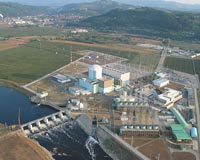
Slovenia's prime minister on Thursday gave his backing to the construction of a second reactor at the country's sole nuclear power plant despite opposition from activists.
Marjan Sarec said another reactor for the Krsko plant near the border with Croatia was needed for the development of the small EU member state.
However, he said he would still seek the advice of experts, and he also needs the support of his coalition partners or other parties in parliament.
"We need to make all the necessary efforts to start building a second bloc (reactor) since we'll be needing more energy in the future, in particular if we want to be a successfully developing country," the centre-left politician said.
He made his comments after visiting the plant which lies about 100 kilometres (60 miles) east of the capital Ljubljana.
The plant, whose 700-megawatt Westinghouse reactor is co-owned by Slovenia and Croatia, was originally due to be switched off in 2023, but Ljubljana and Zagreb decided in 2015 to extend its lifetime by another 20 years.
Krsko covers around 20 percent of Slovenia's electricity needs and 15 percent of Croatia's.
The current reactor was built in the former Yugoslavia and went into service in 1983.
Several activist groups, including Greenpeace, have demanded its dismantling because of its age and because of earthquake risks in the region.
Sarec said nuclear energy was crucial, especially since environmental and civil groups have in the past blocked the construction of wind turbines and new hydro plants arguing that they would damage nature and wildlife.
Russia launches floating nuclear reactor in Arctic despite warnings
Moscow (AFP) Aug 23, 2019 –
Russia will launch the world's first floating nuclear reactor and send it on an epic journey across the Arctic on Friday, despite environmentalists warning of serious risks to the region.
Loaded with nuclear fuel, the Akademik Lomonosov will leave the Arctic port of Murmansk to begin its 5,000 kilometre (3,000-mile) voyage to northeastern Siberia.
Nuclear agency Rosatom says the reactor is a simpler alternative to building a conventional plant on ground that is frozen all year round, and it intends to sell such reactors abroad.
But environmental groups have long warned of the dangers of the project, dubbing it a potential "Chernobyl on ice" and a "nuclear Titanic."
A deadly explosion this month at a military testing site in Russia's far north, causing a radioactive surge, has prompted further concerns.
The reactor's trip is expected to last between four and six weeks, depending on the weather conditions and the amount of ice on the way.
Work began on the 144-metre (472-foot) Akademik Lomonosov in Saint Petersburg in 2006.
When it arrives in Pevek, a town of 5,000 in the Siberian region of Chukotka, it will replace a local nuclear plant and a closed coal plant.
It is due to go into operation by the end of year, mainly serving the region's oil platforms as Russia develops the exploitation of hydrocarbons in the Arctic.
– Radioactive waste –
Rashid Alimov, the head of the energy sector of Greenpeace Russia, said environmental groups had been critical of the idea of a floating reactor since the 1990s.
"Any nuclear power plant produces radioactive waste and can have an accident, but Akademik Lomonosov is additionally vulnerable to storms," he told AFP.
The float is towed by other vessels, making a collision during a storm more likely, he said.
Because Rosatom plans to store spent fuel onboard, Alimov said "any accident involving this fuel might have a serious impact on the fragile environment of the Arctic."
He added that there is "no infrastructure for a nuclear clean up" in the region.
Global warming and melting ice has made the Northeast Passage — which connects the Atlantic Ocean to the Pacific along Russia's northern coast — more accessible.
When AFP visited the Akademik Lomonosov in May 2018, it was a shabby brown colour. It has since been repainted in the red, white and blue of the Russian flag.
The vessel weighs 21,000 tons and has two reactors with a capacity of 35 megawatts each, close to that of those used by nuclear icebreakers.
It has a crew of 69 and travels at a speed of 3.5 to 4.5 knots.
Alimov said the project was a missed opportunity as Chukotka, a region larger than Texas populated by only 50,000 people, "has a huge potential for the development of wind energy."
"A floating nuclear power plant is a too risky and too expensive way of producing electricity," he said.
The nuclear industry, seeking to reinvent itself in a gloomy market, is developing smaller, cheaper reactors to attract new customers.
They follow the examples of submarines, icebreakers and aircraft carriers, which have long used nuclear power, and are intended for isolated areas with little infrastructure.