
CIVIL NUCLEAR
First US nuclear reactor in seven years goes online
by AFP Staff Writers
New York (AFP) July 31, 2023
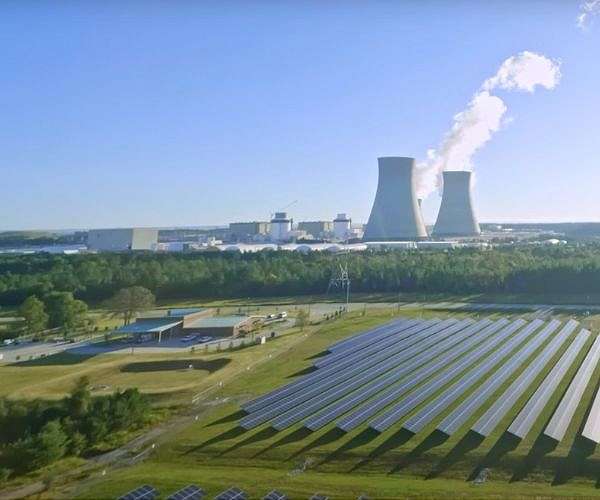
A new reactor at a US nuclear power plant entered into operation Monday, a first in seven years in the country where conventional reactors may give way to smaller-scale nuclear facilities.

The Vogtle Unit 3 near Waynesboro, in the southeastern state of Georgia, has begun serving some 500,000 homes and businesses, operator Georgia Power said in a statement.

"The new unit represents a long-term investment in the state's clean energy future and will provide reliable, emissions-free energy to customers for decades to come," the company said.

The project comes online seven years after it was supposed to start producing power.

The costs for Unit 3, and a fourth reactor anticipated to enter operation in late 2023 or early 2024, have topped $30 billion, according to an estimate by the Municipal Electric Authority of Georgia (MEAP).

That is more than double the budget of $14 billion announced at the start of the project.

Cost overruns pushed original investor Westinghouse, a subsidiary of Japan's Toshiba, to file for bankruptcy in 2017, and it withdrew from the project.

Once all four units are in operation, Vogtle will become the largest generator of clean energy in the nation, according to Georgia Power.

Vogtle Units 3 and 4 were the first new reactor projects approved by US authorities since 1979 and an incident at Pennsylvania's Three Mile Island, the most serious nuclear accident in US history.

The most recent prior commission of a nuclear reactor was Unit 2 at Watts Bar Nuclear Plant in Tennessee, in 2016.

Construction for that reactor had begun in 1973. Work was suspended for more than two decades before the project was revived.

Low-carbon nuclear power has been hailed as a climate-friendly energy source as the world struggles to combat global warming.

Environmentalists, however, worry about safety and warn that disposing radioactive waste carries huge risks.

Since 1990 only three reactors have entered into operation in the United States: the two units at Watts Bar, in 1996 and 2016, and Vogtle Unit 3 on Monday.

No other conventional reactor project is underway.

Construction of two reactors at the Virgil Summer Nuclear Station in South Carolina was abandoned in 2017, despite $9 billion already invested in the projects.

Manufacturers have now reoriented themselves towards smaller, new-generation facilities known as small modular reactors, or SMRs.

The newer designs -- none of which have yet to come into operation in the United States -- are expected to be less expensive, take less time to build and are considered safer than conventional power plants.

Related Links
Nuclear Power News - Nuclear Science, Nuclear Technology
Powering The World in the 21st Century at Energy-Daily.com

Tweet

CIVIL NUCLEAR
Framatome's accident tolerant fuel technology one step closer to market readiness
Washington DC (SPX) Jul 28, 2023
Framatome's industry-first, 100% Enhanced Accident Tolerant Fuel (EATF) assembly successfully completed its first cycle of operation at a U.S. nuclear power plant. This milestone marks significant progress in the development of the accident tolerant fuel (ATF) technology and an important step toward market readiness. Following 24 months of operation, testing and inspections confirm the robust fuel characteristics safely withstood in-reactor conditions and performed as designed. "The accelerated de ... read more

CIVIL NUCLEAR
Harnessing synthetic biology to make sustainable alternatives to petroleum products

University of Illinois study finds turning food waste into bioenergy can become a profitable industry

New technology will let farmers produce their own fertilizer and e-fuels

Clean, sustainable fuels made 'from thin air' and plastic waste

CIVIL NUCLEAR
Solar batteries: a new material makes it possible to simultaneously absorb light and store energy

China's GalaxySpace Debuts Revolutionary Flexible Solar Wing Satellite

New robot boosts solar energy research

AI and satellite imagery transform solar energy potential mapping in China

CIVIL NUCLEAR
U.S. identifies three new areas for potential offshore wind energy development

Biden to visit Philly Shipyard to announce construction of offshore wind vessel

New transmission line to carry wind energy electricity from Wyoming to Nevada

Brazil faces dilemma: endangered macaw vs. wind farm

CIVIL NUCLEAR
UK climate campaigners fear net zero policies under threat

Electrical fire sparks nationwide power outage in Iraq

U.S. pulls plug on incandescent light bulbs as new ban goes into effect

In a warming world, is an air-conditioned future inevitable?

CIVIL NUCLEAR
MIT engineers create an energy-storing supercapacitor from ancient materials

New approach to fuel cell manufacturing could reduce cost, increase availability

Less power, lower emissions: improving AC technology

Fusion model hot off the wall

CIVIL NUCLEAR
EU looks to ban harmful chemicals in imported toys

Lebanese activists fight rampant beachside development

Marine animal poisonings overwhelm California volunteers

France to pay bonus for shoe, clothes repairs to cut waste

CIVIL NUCLEAR
UK to issue 'hundreds' of new oil, gas licences in North Sea

Berlin hails 'progress' in EU talks on hydrogen plants

Iraq and Kuwait seek to solve contested border issue

NASA Armstrong sensor technology helping turn oxygen into fuel

CIVIL NUCLEAR
Mawrth Vallis region - the deepest clay deposits on Mars

Unveiling Mars' Past: Olympus Mons as a Gigantic Volcanic Isle

Sleeping the Sol Away: Sol 3894

Perseverance sees Mars in a new light