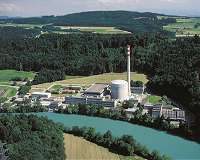
One of four Swiss nuclear power stations was permanently disconnected Friday after 47 years of service, marking a first in Switzerland, as the country begins to gradually phase out atomic energy.
The decision to press the "off" button for good at the ageing Muhleberg plant in western Switzerland came amid soaring upkeep costs, and leaves the wealthy Alpine nation with three remaining nuclear plants in service.
"This is the first ever decommissioning of a power reactor in Switzerland," Swiss energy company BKW, the plant operator, said in a statement.
Since it was commissioned in November 1972, the plant had pumped out some 130 billion kilowatts per hour of electricity, which is enough to cover the current electrical consumption of the Swiss capital Bern's some one million inhabitants for more than a century, BKW said.
The shutdown of the plant officially began at 12:30 pm (1130 GMT), with the decisive button-push transmitted live on Swiss television.
But the full decommissioning process is expected to take around 15 years, with reuse of the site likely possible from 2034.
– 'Truly historic' –
"This is truly a historic day," Swiss Environment Minister Simonetta Sommaruga told public broadcaster RTS earlier this week.
"The halt of the Muhleberg nuclear plant provides opportunities (for growth) of hydraulic energy and solar power," she said.
The plant had become the site of repeated protests amid a raging debate about nuclear safety in Switzerland that intensified following the 2011 Fukushima nuclear disaster in Japan.
In the aftermath of Fukushima, Switzerland announced plans to phase out nuclear energy and close its four plants, but no clear timeline has been set.
In early 2013, Muhlberg's operating license was even extended indefinitely, but just months later, its operator announced its plans to shut it down.
But the decision to close the plant, which has covered around five percent of Switzerland's energy consumption, was not politically motivated, BKW said.
"This was a business decision," the company told AFP in an email.
"If we had wanted to keep running our plant in the long term, we would have needed to invest heavily to respond to the technical requirements stipulated by the Swiss Nuclear Safety Inspectorate (ENSI)," it said.
But the closure does mark a clear first step in Switzerland's planned nuclear phase-out, leaving three plants in operation: Gosgen, Leibstadt and Beznau.
The latter houses two reactors, including one that turned 50 earlier this month, making it Europe's oldest functioning reactor and the third oldest in operation worldwide.
But despite their advanced age and Switzerland's stated ambition to gradually exit nuclear — which accounts for about a third of its current power generation — there are no immediate plans to shut down the remaining reactors.
In a popular vote three years ago, the Swiss rejected a call to speed up the phaseout of the plants by decommissioning all reactors over the age of 45.
As a result, the reactors can run for as long as ENSI deems them safe, or for as long as their operators find it financially viable to invest in the required safety upgrades.