As Western nations look for ways to reduce their reliance on Russian oil and gas, another aspect of the Ukraine crisis has received less attention: Most of the 32 countries that use nuclear power rely on Russia for some part of their nuclear fuel supply chain.
Nuclear power is a critical part of many national electricity grids. European countries especially rely on nuclear power, including France, where it produces 69% of the nation's electricity supply, Ukraine (51%), Hungary (46%), Finland (34%) and Sweden (31%). In the U.S., nuclear reactors generate 20% of the nation's power. Many of these countries originally embraced nuclear power to minimize dependence on imported fossil fuels and, more recently, to reduce carbon emissions and improve air quality.
Economic fallout from the war in Ukraine could disrupt access to fuel for the nuclear power industry. We believe that countering Russia's influence will require concerted efforts that balance energy security, climate mitigation and a commitment to international law.
A global industry
Around the world, 32 countries operate about 440 commercial nuclear power reactors that generate 10% of the world's electricity supply. The U.S. has the most operating reactors (93), followed by France (56) and China (53).
Many nations export nuclear fuel, materials and services. The leading international suppliers are the U.S., Russia, Europe and China. Several other countries play important roles, including Canada and South Korea.
Producing nuclear fuel involves five steps:
– Raw uranium ore, which usually contains less then 2% uranium, is mined from the ground.
– The ore is milled to separate the uranium from other materials, yielding a powder called yellowcake.
– Yellowcake is chemically converted to gaseous uranium hexafluoride.
– Uranium hexafluoride is processed to increase its concentration of uranium-235, which can be split in reactors to produce large quantities of energy. U-235 only makes up 0.7% of natural uranium; enrichment for commercial reactor fuel increases its concentration, usually up to 5%.
– Enriched uranium is fabricated into fuel rods for reactors.
Uranium conversion, enrichment and fabrication are sophisticated technical processes that are handled at a small number of facilities around the world.
Fuels for nuclear reactors are highly specialized and tied to specific reactor designs. Buying a power reactor from a supplier such as Rosatom, Russia's state nuclear company, or the French company Framatome, can lead to decadeslong supply dependencies.
All of these factors make nuclear supply chains more complex, less competitive and harder to shift rapidly than other energy types, such as oil and gas. And since key materials and technologies for civilian nuclear power can also be used to produce weapon-usable nuclear materials, international nuclear sales are subject to strict export controls and trade restrictions.
Russia as a nuclear supplier
Compared to other mined commodities such as cobalt, world uranium resources are spread reasonably widely. Kazakhstan produces more than 40% of the global supply, followed by Canada (12.6%), Australia (12.1%) and Namibia (10%). Russia is a minor player, producing around 5%, while the U.S. and Europe produce less than 1%.
However, much of the milled uranium from Kazakhstan travels through Russia before it is exported to global markets. Other parts of the supply chain also route through Russia. Only a handful of facilities in the world convert milled uranium into uranium hexafluoride; Russia produced approximately one-third of the 2020 supply, much of it made with uranium from Kazakhstan.
Russia also has 43% of the global enrichment capacity, followed by Europe (about 33%), China (16%) and the U.S. (7%). There is some spare capacity in the U.S. and Europe, and China is expanding.
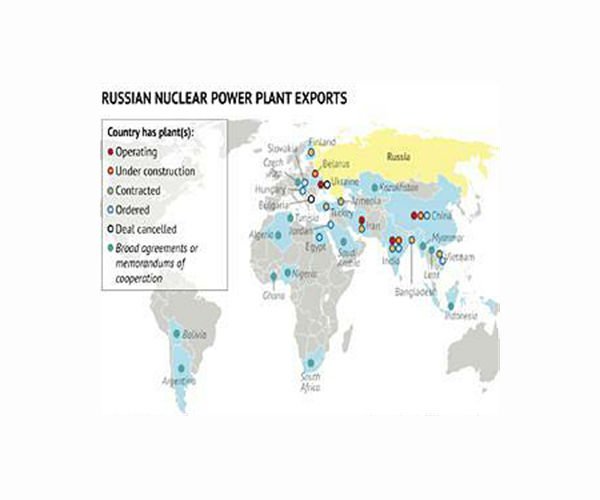
Before it invaded Ukraine, Russia had a national strategy to increase its nuclear energy exports. It is a leading supplier of nuclear reactors, building plants abroad and then providing their fuel. Its customers include former Soviet states and Warsaw Pact members like Ukraine and Hungary, along with new nuclear power users such as Egypt.
Some 16%-20% of the annual U.S. uranium supply is at least partially sourced from Russia, mainly for enrichment. Many European countries buy converted or enriched Russian uranium, and China is a growing market for Russian nuclear exports.
If U.S. nuclear trade with Russia is affected by the Ukraine conflict, the most serious impact would be on two planned advanced reactor demonstration projects: the Xe-100 in Washington state and Natrium in Wyoming. These reactors need fuel that is enriched to nearly 20% uranium-235, and Russia is currently the world's only supplier.