
CIVIL NUCLEAR
TPU researchers discover how to improve safety of nuclear power plants
by Staff Writers
Tomsk Oblast, Russia (SPX) Feb 17, 2020

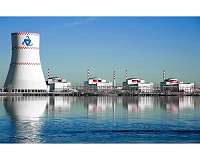
illustration only

Researchers at Tomsk Polytechnic University found a method to increase fuel lifetime by 75%. According to the research team, it will significantly increase safety and reduce the operating cost of nuclear power plants in hard-to-reach areas. The study results were published in Nuclear Engineering and Design.

Previously, a team of researchers from the Russian Federal Nuclear Center - All-Russian Research Institute of Technical Physics, Tomsk Polytechnic University, and the Budker Institute of Nuclear Physics proposed the concept of a thorium hybrid reactor, where high-temperature plasma confined in a long magnetic trap is used to obtain additional neutrons. Unlike operating reactors, the proposed thorium hybrid reactor has moderate power, relatively small size, high operational safety, and low level of radioactive waste.

One of the biggest challenges for the development of remote areas, such as the Far North, is a stable energy supply. According to Tomsk researchers, often the only solution is to use low-power nuclear plants.

However, the reactor refueling, one of the most hazardous and time-consuming procedures in nuclear energy, is a significant problem. "Reduction of refuel frequency will drastically improve operational safety. Furthermore, it reduces transportation costs of fresh fuel or a nuclear power plant to a transshipment site." Vladimir Nesterov, associate professor of the TPU Division for Nuclear-Fuel Cycle, says.

The scientists carried out theoretical calculations proving the possibility of creating a thorium-based nuclear fuel cycle. Thorium is four times as abundant as uranium. Additionally, thorium fuel has a significantly higher regeneration intensity of fissile isotopes necessary for energy production.

"The achieved results can draw the attention of the scientific community to the potential of the thorium nuclear fuel cycle. We demonstrated that the implementation of this cycle in a low-power reactor installation results in increasing of fuel lifetime by 75%," the expert says.

In the future, researchers want to continue experiments in the verified software and carry out thermophysical calculations of low-power reactors operating in the thorium-uranium fuel cycle with subsequent implementation of the developed calculation methods in the educational process.

Research paper


Related Links
Tomsk Polytechnic University
Nuclear Power News - Nuclear Science, Nuclear Technology
Powering The World in the 21st Century at Energy-Daily.com

CIVIL NUCLEAR
Framatome signs contracts with Tennessee Valley Authority
Washington DC (SPX) Feb 04, 2020
Tennessee Valley Authority (TVA) awarded Framatome several multimillion-dollar contracts for work across the company's reactor fleet. This includes fuel for the Browns Ferry Nuclear Plant, fuel handling equipment upgrades across the fleet and steam generator replacements at the Watts Bar Nuclear Plant. "Framatome's long-standing relationship with TVA is the result of our U.S. and global teams' expertise and commitment to delivering excellence in everything they do," said Bernard Fontana, CEO of Fr ... read more

Comment using your Disqus, Facebook, Google or Twitter login.

Share this article via these popular social media networks
del.icio.usdel.icio.us DiggDigg RedditReddit GoogleGoogle

CIVIL NUCLEAR
From petroleum to wood in the chemical industry: cost-efficient and more sustainable

Drilling a 3,000 meters deep well

Water-conducting membrane allows carbon dioxide to transform into fuel more efficiently

Vast amounts of valuable energy, nutrients, water lost in world's fast-rising wastewater streams

CIVIL NUCLEAR
Russian scientists propose a technology reducing the cost of high-efficiency solar cells

NEDO and Panasonic hit 16.09% for largest-area perovskite solar cell module

Oblique electrostatic inject-deposited TiO2 film leads efficient perovskite solar cells

Simple, solar-powered water desalination

CIVIL NUCLEAR
Iberdrola will build its next wind farm in Spain with the most powerful wind turbine

UK looks to offshore wind for green energy transition

Britain's green energy sector brightens: survey data

Consider marine life when implementing offshore renewable power

CIVIL NUCLEAR
EU chief pleads to save green deal in budget holed by Brexit

Eastern EU states opposed to 2050 zero-emissions goal

As nations bicker, a greener future evolves in finance

New research could aid cleaner energy technologies

CIVIL NUCLEAR
Movement of a liquid droplet generates over 5 volts of electricity

Niobium-based connector allows passage of data and electricity underwater for a variety of applications

Smoke, soot and sweat: Egypt's charcoal workers

Scientists learn more about the first hours of a lithium-ion battery's life

CIVIL NUCLEAR
Global cost of air pollution $2.9 trillion a year: NGO report

Multiple eco-crises could trigger 'systemic collapse': scientists

Mark Ruffalo urges EU 'heroism' in chemical pollution fight

UD study maps areas of high Microplastic concentrations in the Delaware Bay

CIVIL NUCLEAR
US to renew Iraq sanctions waiver for 45 days: official

Protecting pipelines during land movements

OPEC chops global oil demand growth forecast over China virus

BP targets net zero carbon emissions by 2050

CIVIL NUCLEAR
MAVEN explores Mars to understand radio interference at Earth

Mars' water was mineral-rich and salty

Russian scientists propose manned Base on Martian Moon to control robots remotely on red planet

To infinity and beyond: interstellar lab unveils space-inspired village for future Mars settlement