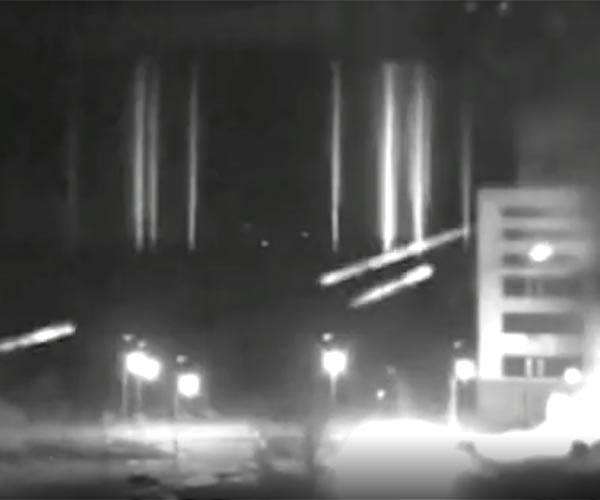
Kyiv and Moscow have exchanged blame for fresh shelling around Europe's largest nuclear facility, which is in Russia's control and has come under fire repeatedly in the past week.
The Zaporizhzhia plant in southeastern Ukraine has been occupied by Russian forces since March, and Kyiv has accused Moscow of basing hundreds of soldiers and storing arms there.
During his televised address on Saturday, Ukrainian President Volodymyr Zelensky accused Russia of nuclear "blackmail" and using the plant to "intimidate people in an extremely cynical way."
"They arrange constant provocations with shelling of the territory of the nuclear power plant and try to bring their additional forces in this direction to blackmail our state and the entire free world even more," Zelensky said.
He added that Russian forces were "hiding" behind the plant to stage bombings on the Ukrainian-controlled towns of Nikopol and Marganets.
Ukraine's nuclear agency Energoatom warned residents in the city of Energodar, where the plant is located, to stay off the streets as much as possible to avoid ongoing Russian shelling.
"According to residents, there is new shelling in the direction of the nuclear plant… the time between the start and arrival of the shelling is 3-5 seconds," Energoatom said on Saturday in a message shared on Telegram from a local chief in Energodar city, which remains loyal to Kyiv.
But pro-Moscow officials in the occupied areas of Zaporizhzhia blamed the shelling on Ukrainian forces.
"Energodar and the Zaporizhzhia nuclear plant are again under fire by (Ukrainian President Volodymyr) Zelensky's militants," said Vladimir Rogov, a member of the Moscow-installed administration.
The missiles fell "in the areas located on the banks of the Dnipro river and in the plant", he said, without reporting any casualties or damage.
The river divides the areas occupied by Russia and those under Ukraine's control.
– Nuclear catastrophe –
Kyiv and Moscow have traded accusations over several rounds of shelling on the plant this month, with the strikes raising fears of a nuclear catastrophe.
The UN Security Council held an emergency over the situation on Thursday and warned of a "grave" crisis unfolding in Zaporizhzhia.
Ukraine said the first strikes on August 5 hit a high-voltage power cable and forced one of the reactors to stop working.
Then strikes on Thursday damaged a pumping station and radiation sensors.
Backed by Western allies, Ukraine has called for a demilitarised zone around the plant and demanded the withdrawal of Russian forces.
In the leafy hilltop town of Marganets, 13 kilometres (eight miles) from the nuclear facility and still in Ukrainian control, residents view the facility across the shimmering river with a dark sense of reality.
"You know, if we die, then it'll happen within one second, we won't suffer," 30-year-old Anastasiia told AFP on Friday.
"It calms me down that my child and my family will not be in pain."
The Ukrainian military has warned against visiting the shore of the Dnipro, fearing enemy troops could open fire from the other side of the river.
"There is constant fear. And the news says the situation at the plant is very tense, so it becomes more terrible with every passing second," said 18-year-old Ksenia, serving customers from a coffee kiosk along the town's main shopping strip.
"You're just afraid to go to bed because at night terrible things happen here."
Ukraine nuclear plant risks increasing 'every day'
Kyiv, Ukraine (AFP) Aug 14, 2022 – The risk of disaster at Europe's largest nuclear plant is "increasing every day", the mayor of the city where it is located told AFP on Sunday, after Ukraine and Russia exchanged blame for fresh shelling around the facility.
The Zaporizhzhia plant in southeastern Ukraine has been occupied by Russian forces since March, and Kyiv has accused Moscow of basing hundreds of soldiers and storing arms there.
The facility has come under fire repeatedly in the past week, raising the spectre of a nuclear catastrophe.
"What is happening there is outright nuclear terrorism, and it can end unpredictably at any moment," said Dmytro Orlov, the mayor of Energodar city where the plant is based.
"The risks are increasing every day," he told AFP by telephone from the Ukrainian-controlled city of Zaporizhzhia.
He said there was mortar shelling on the plant "every day and night".
"The situation is hazardous, and what causes the most concern is that there is no de-escalation process," he added.
– 'Blackmail' –
Ukrainian President Volodymyr Zelensky previously accused Russia of nuclear "blackmail" and using the plant to "intimidate people in an extremely cynical way".
He has also said Russian troops were "hiding" behind the plant to stage bombings on the Ukrainian-controlled towns of Nikopol and Marganets.
But pro-Moscow officials in the occupied areas of Zaporizhzhia blamed the shelling on Ukrainian forces.
Missiles fell "in the areas located on the banks of the Dnipro river and in the plant", said Vladimir Rogov, a member of the Moscow-installed administration, without reporting any casualties or damage.
The river divides the areas occupied by Russia and those under Ukraine's control.
Orlov said over the past 24 hours, Energodar — which he left at the end of April — was shelled for the first time leading to a dramatic increase in those hoping to evacuate.
Amid safety fears, he warned that in the "near future" there may not be enough personnel to man the station.
– Nuclear catastrophe –
Kyiv and Moscow have traded accusations over several rounds of shelling on the plant this month, with the strikes raising fears of a nuclear catastrophe.
In the village of Vyshchetarasivka, on the opposite bank of the Dnipro to the plant, resident Viktor Shabanin said the latest developments had left people "nervous".
"Often the wind blows in our direction. So the radiation will go immediately to us, and the radiation will go into the water," the 57-year-old added.
AFP correspondents on the ground heard air raid sirens and distant strikes on Sunday but reported no fresh fighting around the facility.
The UN Security Council held an emergency meeting over the situation on Thursday and warned of a "grave" crisis unfolding in Zaporizhzhia.
The alarm over Zaporizhzhia has revived painful memories of the 1986 Chernobyl disaster — the world's worst nuclear accident — that struck Ukraine when it was part of the Soviet Union and spread radioactive dust and ash across Europe.
Anastasiya Rudenko believes her late husband, who worked to decontaminate the Chernobyl disaster zone, died of bladder cancer in 2014 due to radiation.
"We could have the same fate as the people of Chernobyl," the 63-year-old told AFP.
"There's nothing good in what's going on, and we don't know how it will end."
Backed by Western allies, Ukraine has called for a demilitarised zone around the plant and demanded the withdrawal of Russian forces.
– UN grain ready to leave –
Russian forces trying to press their offensive near the Dnipro in the southern Kherson region are under pressure after strategically important bridges were damaged, a Ukrainian politician said on Sunday.
Regional lawmaker Sergiy Khlan said the pontoons the Russians are using cannot fully meet their needs and that command centres were being moved as they risked being cut off from supplies.
In his daily address on Sunday, Zelensky backed the idea of a blanket ban by the European Union on visas for all Russian travellers, currently being mulled by the Czech Republic, which holds the rotating EU presidency.
"The discussion… is expanding every day, new states and new politicians are joining it. Ultimately, this should lead to appropriate decisions."
He also said the Ukrainian parliament would make a decision "in the near future" on extending martial law.
A major consequence of the war has been soaring food prices after a Russian naval blockade and Kyiv's mining of its ports prevented Ukrainian grain from being sold on global markets.
A landmark deal last month between Russia and Ukraine brokered by Turkey and the United Nations created safe corridors to allow key grain exports to resume.
Kyiv on Sunday said the first UN-chartered vessel transporting grain from Ukraine to relieve the global food crisis was loaded with 23,000 tonnes of wheat and is ready to depart.
Ukrainian Infrastructure Minister Oleksandr Kubrakov said the MV Brave Commander, currently in the Black Sea port of Pivdennyi, will head to Africa with a 23,000-tonne cargo of wheat.