
 |
 |
 |
 |
 |
 |
 |
 |
 |

 |

Bristol, UK (SPX) Nov 03, 2010 Researchers at the University of Bristol have revealed in the journal Nature that they have developed a seismological 'speed gun' for the inside of the Earth. Using this technique they will be able to measure the way the Earth's deep interior slowly moves around. This mantle motion is what controls the location of our continents and oceans, and where the tectonic plates collide to shake the surface we live on. For 2,900 km (1800 miles) beneath our feet, the Earth is made of the rocky mantle. Although solid, it is so hot that it can flow like putty over millions of years. It is heated from below, so that it circulates like water on a stove. While geophysicists know something about how the material moves by the time it reaches the top of the mantle, what goes on at the bottom is still a puzzle. However researchers need to know both to predict how the Earth's surface-our home-will behave. Andy Nowacki, at the School of Earth Sciences at Bristol University, explained: "The only way to measure the inside of the Earth at such huge depths is with seismic waves. When a large earthquake occurs and waves travel through the Earth, they are affected in different ways, and we can examine their properties to work out what is happening thousands of miles beneath our feet, a region where we can never go. "This study focusses on a mysterious layer where the mantle meets the core, a sphere of iron at the centre of the Earth 7,000 km (4400 miles) across. This part just above the core has curious properties which we can measure using seismic waves that pass through it." This enigmatic part of the Earth is known as D? (pronounced 'dee-double-prime'). Dr James Wookey said: "We believe that D? is made from crystals which line up in a certain orientation when the mantle flows. We can measure how they line up, and in this study we do this for one part of the world - North and Central America. In the future our method can then be used to see which direction the mantle is moving everywhere." Professor Mike Kendall added: "This part of the Earth is incredibly important. The lowermost mantle is where two colossal, churning engines-the mantle and the core-meet and interact. The core is moving very quickly and creates our magnetic field which protects us from the Sun's rays. "The mantle above is sluggish, but drives the motion of the plates on the Earth's surface, which build mountains, feed volcanoes and cause earthquakes. Measuring the flow in the lowermost mantle is vital to understanding the long term evolution of the Earth."
Share This Article With Planet Earth
Related Links University of Bristol Tectonic Science and News

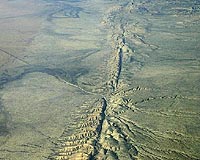 San Andreas fault said 'ready to go'
Los Angeles (UPI) Oct 8, 2010 A section of the San Andreas Fault in California is overdue for a major earthquake that could reach 8.1 magnitude, researchers say. If or when it happens, seismologists say, the earthquake could run 340 miles from Monterey in central California south to the Salton Sea, the Los Angeles Times reported. Experts previously believed a major section of the fault 100 miles northwest of ... read more |
|
|
| The content herein, unless otherwise known to be public domain, are Copyright 1995-2010 - SpaceDaily. AFP and UPI Wire Stories are copyright Agence France-Presse and United Press International. ESA Portal Reports are copyright European Space Agency. All NASA sourced material is public domain. Additional copyrights may apply in whole or part to other bona fide parties. Advertising does not imply endorsement,agreement or approval of any opinions, statements or information provided by SpaceDaily on any Web page published or hosted by SpaceDaily. Privacy Statement |


 del.icio.us
 Digg
Digg Reddit
 YahooMyWeb
 Google
 Facebook


