
 |
 |
 |
 |
 |
 |
 |
 |
 |

 |

Washington DC (SPX) Aug 27, 2010 The Army is now crafting an integrated approach to aircraft survivability that combines input from multiple on-board sensors and uses that information to detect, track and defeat incoming enemy fire. By combining input from a variety of different survivability systems now on-board rotary aircraft into a single system and display screen, the Army can streamline threat information delivery and at the same time reduce the size, weight and power requirements for its aircraft, said Col. John Leaphart, project manager for aircraft survivability equipment. "Right now we have multiple product lines - three or four different systems that do different things," said Leaphart. "We need to move toward a more integrated approach, which in the future means a suite of sensors and a suite of countermeasures that are controlled by a common processor that runs all of them in a holistic fashion." Leaphart said such a system would save development and procurement dollars. But more importantly, he said, a combined system would weigh less than multiple systems, which reduced aircraft weight. Such a system would also consume less power on the aircraft. The Army is now working on computer algorithms able to combine input from a range of different aircraft technologies including CMWS and various now-in-development technologies, such as the Hostile Fire Detection System and the Common Infrared Countermeasure system. The CIRCM system is an improved, lighter-weight version of Advanced Threat Infrared Countermeasures - a high-tech laser jammer that is able to thwart guided-missile attacks on helicopters by using an infrared sensor designed to track an approaching missile. The system fires a multiband heat laser to intercept the missile and throw it off course, Leaphart explained. "Right now pilots are looking at multiple displays and we need to get to a common display," he said. "We are working on wrapping the acquisition strategy around this so that we achieve a gradual migration toward a more integrated approach." A key example of this move toward integration is a new effort called the Hostile Fire Detection System. The HFDS combines ultraviolet and acoustic sensory input to thwart small arms fire. "One of the big things we are facing right now in theater is small arms fire, so we are looking at developing this HFDS. We are getting ready to produce a quick reaction capability that involves a piece of software that will go into the processor for CMWS and give it the ability to detect tracer fire and other threats," Leaphart said. HFDS works off of the UV sensor in the CMWS systems and adds an algorithm into the process which enables it to differentiate tracer fire from a missile launch. "This is bringing a new capability into an existing system which makes that system more effective against a broader spectrum of threats," he explained. The next step is to connect the UV sensor to an acoustic sensor so as to better detect multiple sources of incoming fire. The CMWS has already proven itself in combat. "The CMWS does reduce the immediate reaction workload of responding to a missile threat," said Chief Warrant Officer Pat Shores, Aviation Branch Tactical Operations Officer; Directorate of Training and Doctrine, U.S. Army Aviation Center of Excellence. "This also enables the crew to react faster to destroying the threat on the ground." Shores said he thinks America's enemies find out too late just how effective system like CMWS actually are. "Shooting a missile at Army aircraft is a lose-lose situation for them," Shores said. "They have an extremely low probability of a hit, and due to the CMWS and similar systems, they also have a high probability being detected and destroyed after the shot." The CIRCM program, planned as a multi-service survivability solution for rotary-wing aircraft, aims to improve on and capture lessons learned from the now-fielded ATIRCM technology. CIRCM is preparing to enter a competitive development prototyping phase, Leaphart said. A formal request for proposal for CIRCM is planned for release by the fourth quarter of this year. "The acquisition strategy is we will do a tech-development phase with multiple companies in competition with each other. They will develop two prototypes that will be evaluated during this phase. For engineering development, a market survey will be conducted and if warranted, a limited competition between these two vendors will occur for EMD with a manufacturing phase for one of those," Leaphart said. ATIRCM is fielded now on helicopters over Iraq and Afghanistan. CIRCM, its replacement, lowers the weight of the system and therefore brings with it the opportunity to deploy this kind of laser counter-measure across a wider portion of the fleet. "This will give the rotary wing fleet the capability to defeat IR missiles that they don't have right now. CIRCM has a laser emitter as part of the turret - guided by an IR pointer. This points the laser on the IR seeker of the inbound missile. Shooting the laser into the IR seeker essentially blinds the missile," Leaphart explained. Testing and development of CIRCM will take place at a variety of locations, to include Redstone Arsenal, Ala., and Eglin AFB, Fla. Production is slated to begin by 2015.
Share This Article With Planet Earth
Related Links US Army The latest in Military Technology for the 21st century at SpaceWar.com

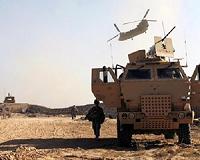 Army Crafts Tailorable Tactical Wheeled Vehicle Acquisition Strategy
Washington DC (SPX) Aug 26, 2010 The U.S. Army has released its tactical wheeled vehicle acquisition strategy report to Congress, calling for a tailorable approach to vehicle procurement to include new buys and repair, sustainment and recapitalization of the existing fleet. The acquisition strategy lays out a roadmap for tactical wheeled vehicles, including the Mine Resistant Ambush Protected, or MRAP, vehicles from 2010 ... read more |
|
|
| The content herein, unless otherwise known to be public domain, are Copyright 1995-2010 - SpaceDaily. AFP and UPI Wire Stories are copyright Agence France-Presse and United Press International. ESA Portal Reports are copyright European Space Agency. All NASA sourced material is public domain. Additional copyrights may apply in whole or part to other bona fide parties. Advertising does not imply endorsement,agreement or approval of any opinions, statements or information provided by SpaceDaily on any Web page published or hosted by SpaceDaily. Privacy Statement |


 del.icio.us
 Digg
Digg Reddit
 YahooMyWeb
 Google
 Facebook


