
 |
 |
 |
 |
 |
 |
 |
 |
 |

 |

for Launchspace Bethesda MD (SPX) Feb 08, 2011 Imagine it is June 30, 1908 and you are in Siberia. The time is just after seven in the morning. Suddenly a pressure wave knocks you off your feet and a few moments later a blast of heat is so intense that you think your shirt is on fire. This is what a witness felt some 40 miles away from ground zero in the Tunguska event, over 100 years ago. This is the only recorded entry of a large natural space object in modern history. Nineteen years later, when an expedition could finally reach the rugged Siberian outback, they found that 800 square miles of remote forest had been ripped apart and an estimated 80 million trees lay on their sides, arranged in a radial pattern centered at the blast epicenter. Strangely, at ground zero the explorers found trees standing upright, but their limbs and bark had been stripped away. The scene was much like a forest of telephone poles. Our witness later recounted the event: Suddenly in the north sky, the sky was split in two, and high above the forest the whole northern part of the sky appeared covered with fire. At that moment there was a bang in the sky and a mighty crash. The crash was followed by a noise like stones falling from the sky, or of guns firing. The earth trembled. The massive explosion caused a seismic shockwave that registered with sensitive barometers as far away as England. Dense, high-altitude clouds formed over the region and reflected sunlight from beyond the horizon. The night skies glowed, and there were reports that people who lived as far away as Asia could read outdoors until midnight. Although many still debate what happened, the general consensus is that a large space rock, about 120 feet across with a mass of roughly 220 million pounds, entered the atmosphere above Siberia and detonated at high altitude. The atmospheric entry speed was estimated at about 33,500 miles per hour. Calculations indicate this rock heated the air surrounding it to 44,500 degrees Fahrenheit. At an estimated altitude of 28,000 feet, the combination of pressure and heat caused the asteroid to explode, producing a fireball and releasing energy equivalent to about 185 Hiroshima bombs. Thus, there was no impact point or crater, i. e., the asteroid was consumed in the explosion. NASA's JPL operates the Near-Earth Object Office and it is tasked with plotting the orbits of present-day comets and asteroids that cross Earth's path, and could be potentially hazardous to the planet. Experts estimate that, on average, a Tunguska-sized asteroid will enter Earth's atmosphere once every 300 years. Not only is NASA tracking wayward asteroids, the space agency is also thinking ahead and is studying methods and options for diverting asteroids that appear to be headed toward Earth. Although there appears to be no viable solution yet, several approaches have been studied. One such approach consists of six missile-like interceptor vehicles that would launch aboard a future large launch vehicle, such as the proposed Ares V. Each interceptor would carry a 1.2-megaton nuclear warhead. That, NASA says, should be enough to deflect an asteroid the size of Apophis, expected to pass near Earth during April 2029. The concept requires the warheads to detonate near the asteroid, generating a force that would (theoretically) deflect it out of the Earth's path. No doubt, there will a rash of Hollywood films about asteroid busting that will be released in the 2020 to 2030 era. Surely, at least one of these will be a comedy entitled, Asteroid Busters.
Share This Article With Planet Earth
Related Links Launchspace Asteroid and Comet Mission News, Science and Technology

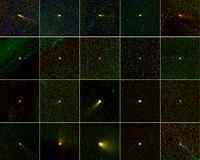 NASA's NEOWISE Completes Scan For Asteroids And Comets
Pasadena CA (JPL) Feb 03, 2011 NASA's NEOWISE mission has completed its survey of small bodies, asteroids and comets, in our solar system. The mission's discoveries of previously unknown objects include 20 comets, more than 33,000 asteroids in the main belt between Mars and Jupiter, and 134 near-Earth objects (NEOs). The NEOs are asteroids and comets with orbits that come within 45 million kilometers (28 million miles) of Ear ... read more |
|
|
| The content herein, unless otherwise known to be public domain, are Copyright 1995-2010 - SpaceDaily. AFP and UPI Wire Stories are copyright Agence France-Presse and United Press International. ESA Portal Reports are copyright European Space Agency. All NASA sourced material is public domain. Additional copyrights may apply in whole or part to other bona fide parties. Advertising does not imply endorsement,agreement or approval of any opinions, statements or information provided by SpaceDaily on any Web page published or hosted by SpaceDaily. Privacy Statement |


 del.icio.us
 Digg
Digg Reddit
 YahooMyWeb
 Google
 Facebook


