
 |
 |
 |
 |
 |
 |
 |
 |
 |

 |
Astronomers Catch Binary Star Explosion Inside Nebula
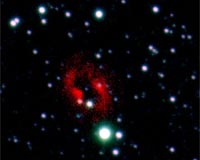
London, UK (SPX) Nov 21, 2008 The explosion of a binary star inside a planetary nebula has been captured by a team led by UCL (University College London) researchers - an event that has not been witnessed for more than 100 years. The study, published in Astrophysical Journal Letters, predicts that the combined mass of the two stars in the system may be high enough for the stars to eventually spiral into each other, triggering a much bigger supernova explosion. Dr Roger Wesson, UCL Physics and Astronomy, says: "At the ends of their lives, some stars undergo nova explosions, caused by nuclear reactions on their surface. In August 2007, one such exploding star was discovered in a part of the sky that had serendipitously been observed by us only a few weeks previously. The pre-explosion images showed that this particular star was surrounded by a planetary nebula. "Although several novae are discovered each year in our Galaxy, this is only the second time that a nova has been seen inside a planetary nebula, the first being over 100 years ago. Now, the light flash from the explosion is passing through and illuminating the surrounding nebula. This object poses a major challenge to current theories of how stars evolve and could be a Rosetta Stone in understanding some aspects of the lives of stars." "The pre-explosion images were taken as part of the Isaac Newton Telescope Photometric HAlpha Survey (IPHAS), the first digital survey of the Milky Way in visible light, and the most comprehensive yet in the light emitted by hydrogen (the most abundant element in the universe). "The star which erupted was a nova, an event caused when matter is transferred from one star in a close binary system onto its companion, eventually triggering a runaway thermonuclear explosion. The nebula surrounding this nova is a planetary nebula, which must have formed during an earlier phase in the binary star's existence, when the outer layers of one of the companions were expelled. Only one previous nova has been seen to occur inside a planetary nebula - Nova Persei in 1901. The opportunity to watch in detail as the nova flash interacts with the nebula is a first in astronomy. "The new nova, known as V458 Vulpeculae, provides an important test for models of how stars evolve. Our analysis also suggests that the combined mass of the two stars which produced the explosion could be high enough that eventually, the two stars will spiral into each other, producing a much larger supernova explosion. The role of novae as potential future supernovae has thus far been difficult to analyse in detail, and so V458 Vul provides an opportunity to learn more about this aspect of stellar evolution." Share This Article With Planet Earth
Related Links University College London Stellar Chemistry, The Universe And All Within It
 XMM-Newton And Integral Clues On Magnetic Powerhouses
 Paris, France (ESA) Nov 18, 2008
X-ray and gamma-ray data from ESA's XMM-Newton and Integral orbiting observatories has been used to test, for the first time, the physical processes that make magnetars, an atypical class of neutron stars, shine in X-rays. |
|
|

| The content herein, unless otherwise known to be public domain, are Copyright 1995-2007 - SpaceDaily.AFP and UPI Wire Stories are copyright Agence France-Presse and United Press International. ESA Portal Reports are copyright European Space Agency. All NASA sourced material is public domain. Additional copyrights may apply in whole or part to other bona fide parties. Advertising does not imply endorsement,agreement or approval of any opinions, statements or information provided by SpaceDaily on any Web page published or hosted by SpaceDaily. Privacy Statement |
 del.icio.us
 Digg
Digg Reddit
 YahooMyWeb
 Google
 Facebook