
 |
 |
 |
 |
 |
 |
 |
 |
 |

 |
Astronomy Question Of The Week: How Fast Is The Earth Moving
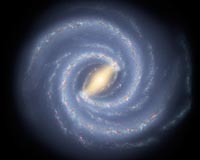
Bonn, Germany (SPX) Mar 18, 2009 In order to answer this question, we must first make sure we are aware of what is know as the frame of reference. A surfer hardly moves at all, relative to the wave he is on, but seen from the shore he is rushing towards the observer. Cosmic background radiation provides an absolute reference system for speed in space. It is measured coming almost completely uniformly from every direction of space with a temperature of approximately minus 270 degrees Celsius. A movement in a certain direction can be proven and measured by means of a very slight change in this temperature. In addition, we must bear in mind that the Earth is simultaneously moving in different ways. It rotates around its polar axis, it orbits the Sun, it moves within the Milky Way as a part of the Solar System and it moves through the Universe as part of the Milky Way. The larger the linear scales observed, the greater the Earth's speed.The turning of the Earth around its axis, the Earth's rotation, means that a point on the equator is travelling at a speed of around 1,670 kilometres per hour, or 464 metres per second. The Earth already has a speed of almost 30 kilometres per second on its path around the Sun. It becomes even faster when we observe our galaxy, the Milky Way. The Sun is located around 25,000 light years (one light year = about 9.5 trillion kilometres) from the centre of the Milky Way and needs approximately 240 million years for one orbit. The Sun and the Earth, which move with it as part of the Solar System, have a speed of 220 kilometres per second. On the basis of measurements, scientists have deduced that the various speed components of our Solar System, which have different directions and therefore partly cancel each other out, add up to about 370 kilometres per second. The Milky Way and its neighbouring galaxies form the so-called Local Group. A speed of around 630 kilometres per second has been calculated for this galaxy cluster. The speeds listed here cannot simply be added up to arrive at an overall speed, however, due to the fact that they refer to movements in different directions. Share This Article With Planet Earth
Related Links German Aerospace Center Stellar Chemistry, The Universe And All Within It
 New Space Show Highlights IBEX's Mission Of Discovery
 San Antonio TX (SPX) Mar 09, 2009
As part of its education and public outreach efforts, the story of NASA's Interstellar Boundary Explorer (IBEX) mission has been chronicled in a space show premiering this month at the Adler Planetarium in Chicago. The show also is being distributed free of charge and will be opening shortly in planetaria worldwide. |
|
|

| The content herein, unless otherwise known to be public domain, are Copyright 1995-2007 - SpaceDaily.AFP and UPI Wire Stories are copyright Agence France-Presse and United Press International. ESA Portal Reports are copyright European Space Agency. All NASA sourced material is public domain. Additional copyrights may apply in whole or part to other bona fide parties. Advertising does not imply endorsement,agreement or approval of any opinions, statements or information provided by SpaceDaily on any Web page published or hosted by SpaceDaily. Privacy Statement |
 del.icio.us
 Digg
Digg Reddit
 YahooMyWeb
 Google
 Facebook