
 |
 |
 |
 |
 |
 |
 |
 |
 |

 |

Cambridge MA (SPX) Aug 03, 2010 Sky viewers might get to enjoy some spectacular Northern Lights, or aurorae, tomorrow. After a long slumber, the Sun is waking up. Early Sunday morning, the Sun's surface erupted and blasted tons of plasma (ionized atoms) into interplanetary space. That plasma is headed our way, and when it arrives, it could create a spectacular light show. "This eruption is directed right at us, and is expected to get here early in the day on August 4th," said astronomer Leon Golub of the Harvard-Smithsonian Center for Astrophysics (CfA). "It's the first major Earth-directed eruption in quite some time." The eruption, called a coronal mass ejection, was caught on camera by NASA's Solar Dynamics Observatory (SDO) - a spacecraft that launched in February. SDO provides better-than-HD quality views of the Sun at a variety of wavelengths. "We got a beautiful view of this eruption," said Golub. "And there might be more beautiful views to come, if it triggers aurorae." When a coronal mass ejection reaches Earth, it interacts with our planet's magnetic field, potentially creating a geomagnetic storm. Solar particles stream down the field lines toward Earth's poles. Those particles collide with atoms of nitrogen and oxygen in the atmosphere, which then glow like miniature neon signs. Aurorae normally are visible only at high latitudes. However, during a geomagnetic storm aurorae can light up the sky at lower latitudes. Sky watchers in the northern U.S. and other countries should look toward the north on the evening of August 3rd/4th for rippling "curtains" of green and red light. The Sun goes through a regular activity cycle about 11 years long on average. The last solar maximum occurred in 2001. Its latest minimum was particularly weak and long lasting. This eruption is one of the first signs that the Sun is waking up and heading toward another maximum.
Share This Article With Planet Earth
Related Links Harvard-Smithsonian Center for Astrophysics Solar Science News at SpaceDaily

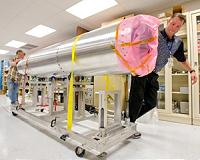 Taking A Shot At The Sun
Huntsville AL (SPX) Aug 02, 2010 For a thrilling eight minutes, NASA researchers will soon get a peek at one of the sun's most mysterious regions, where temperatures fluctuate from tens of thousands of degrees Fahrenheit to several million, and solar flares and coronal mass ejections originate - potentially threatening spacecraft, Earth-based communications and the lives of explorers in space. To learn more about this tur ... read more |
|
|
| The content herein, unless otherwise known to be public domain, are Copyright 1995-2010 - SpaceDaily. AFP and UPI Wire Stories are copyright Agence France-Presse and United Press International. ESA Portal Reports are copyright European Space Agency. All NASA sourced material is public domain. Additional copyrights may apply in whole or part to other bona fide parties. Advertising does not imply endorsement,agreement or approval of any opinions, statements or information provided by SpaceDaily on any Web page published or hosted by SpaceDaily. Privacy Statement |


 del.icio.us
 Digg
Digg Reddit
 YahooMyWeb
 Google
 Facebook


