
 |
 |
 |
 |
 |
 |
 |
 |
 |

 |

Nairobi (AFP) Feb 23, 2011 Curbing sooty particles emitted by burning biomass and smog caused by traffic fumes would slow the onslaught of climate change and deliver many health benefits, a UN report said here on Wednesday. Removing these sources of pollution by 2030 would clip 0.5 degrees Celsius (0.9 degrees Fahrenheit) off the expected 1.0 C (1.8 F) rise in global warming by mid-century, it said. The biggest beneficiaries would be the Arctic, the Himalayas and other glaciated regions that are highly vulnerable to warming. Health benefits would be almost immediate, by ending a major source of respiratory illness, it said. The report, authored by specialists for the UN Environment Programme (UNEP) and World Meteorological Organisation (WMO), has been submitted to environment ministers from around the globe. They are meeting in Nairobi until Thursday for talks on how to overhaul governance of the world's environment ahead of a gathering next year to mark the 20th anniversary of the famous 1992 Rio Summit. The 32-page report touches on two major pollutants: "black carbon," or soot-like particles that are emitted by burning wood or biomass, and ground-level ozone, a gas that results from a chemical reaction between traffic exhaust fumes and sunlight. Clouds of black carbon become charged with heat by absorbing sunlight,and can alter weather patterns such as the monsoon. Black carbon is a respiratory hazard, as is ozone, a triple-atom molecule of oxygen that in the stratosphere plays an important role in shielding Earth from ultraviolet radiation. Man-made ozone in the lower levels of the atmosphere is a major component of smog and the third biggest greenhouse gas after carbon dioxide -- the direct byproduct of burning fossil fuels -- and methane, which comes from forests and land use. It is also damaging to plants. Pam Pearson of the International Cryosphere Climate Initiative, said that in glaciated regions, temperatures are rising at double the rate of increase elsewhere. The Arctic was especially hit because it was close to the industrialised countries of the northern hemisphere. "Some scientists estimate the impact of just black carbon that lands on ice and snow may be as much as (the impact of) CO2 in the Arctic," she said on the sidelines of a presentation of the report in Nairobi. UN-led efforts to tackle global warming gases have been stymied by national differences over how to apportion the cost of weaning the world off dependence on oil, gas and coal and improving energy efficiency. The new report said that addressing black carbon and ozone through pollution controls offered early benefits in addressing the warming problem, although this did not exclude the urgency of tackling fossil-fuel CO2. It did not make any estimate of the cost, saying further work on this was needed. Daniel Reifsnyder, US deputy assistant secretary for the environment and sustainable development, told the experts gathered that a two-pronged attack was needed. "We all need to recognise that slowing the near-term rate of warming by acting on short-lived forces does not buy us time to act on carbon dioxide," he said. "We need to act now on CO2 because today's emissions will affect the earth's climate for centuries to come," he said. "What agreeing on near-term warming can do for us is to slow down the alarming rate of change we've seen in the Arctic and elsewhere, and in the process delay the onset of some feedbacks that further accelerate warming."
Share This Article With Planet Earth
Related Links Climate Science News - Modeling, Mitigation Adaptation

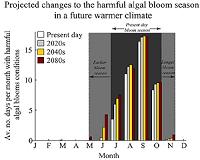 Climate Projections Show Human Health Impacts Possible Within 30 Years
Washington DC (SPX) Feb 23, 2011 A panel of scientists speaking at the annual meeting of the American Association for the Advancement of Science (AAAS) unveiled new research and models demonstrating how climate change could increase exposure and risk of human illness originating from ocean, coastal and Great Lakes ecosystems, with some studies projecting impacts to be felt within 30 years. "With 2010 the wettest year on r ... read more |
|
|
| The content herein, unless otherwise known to be public domain, are Copyright 1995-2010 - SpaceDaily. AFP and UPI Wire Stories are copyright Agence France-Presse and United Press International. ESA Portal Reports are copyright European Space Agency. All NASA sourced material is public domain. Additional copyrights may apply in whole or part to other bona fide parties. Advertising does not imply endorsement,agreement or approval of any opinions, statements or information provided by SpaceDaily on any Web page published or hosted by SpaceDaily. Privacy Statement |


 del.icio.us
 Digg
Digg Reddit
 YahooMyWeb
 Google
 Facebook


