
 |
 |
 |
 |
 |
 |
 |
 |
 |

 |

Phoenix (UPI) Feb 10, 2011 U.S. researchers say fossil evidence suggests a key human ancestor could walk upright consistently, a major advance in human evolution. A 3.2-million-year-old foot bone found at Hadar, Ethiopia, indicates the diminutive, human-like species Australopithecus afarensis had arches in its feet, suggesting upright locomotion, the BBC reported Thursday. Arched feet, the researchers say, are critical for walking the way modern humans do. "[The bone] gives a glimpse of foot anatomy and function," says William Kimbel, director of the Institute of Human Origins at Arizona State University. "The bone that was recovered from the Hadar site has all the hallmarks of the form and function of the modern human foot." Paleontologists knew A. afarensis spent some of its time standing up from examination of the first discovered skeleton of the species, dubbed "Lucy," also found near Hadar in the Ethiopian rift valley. But the absence of important foot bones in all the specimens found so far made it difficult for researchers to determine exactly how much time Lucy and her kin spent on their feet, as opposed to moving through the branches of trees. Other features of the skeletons, like the spine and leg bones, suggested upright walking. "Now we can say that the foot, too, joins these other anatomical regions in pointing towards a fundamentally human-like form of locomotion in this ancient human ancestor," Kimbel says.
Share This Article With Planet Earth
Related Links All About Human Beings and How We Got To Be Here

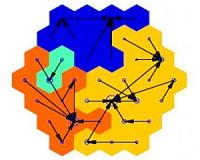 Mathematical Model Explains How Complex Societies Emerge And Collapse
Bethesda MD (SPX) Jan 21, 2011 The instability of large, complex societies is a predictable phenomenon, according to a new mathematical model that explores the emergence of early human societies via warfare. Capturing hundreds of years of human history, the model reveals the dynamical nature of societies, which can be difficult to uncover in archaeological data. The research, led Sergey Gavrilets, associate director for ... read more |
|
|
| The content herein, unless otherwise known to be public domain, are Copyright 1995-2010 - SpaceDaily. AFP and UPI Wire Stories are copyright Agence France-Presse and United Press International. ESA Portal Reports are copyright European Space Agency. All NASA sourced material is public domain. Additional copyrights may apply in whole or part to other bona fide parties. Advertising does not imply endorsement,agreement or approval of any opinions, statements or information provided by SpaceDaily on any Web page published or hosted by SpaceDaily. Privacy Statement |


 del.icio.us
 Digg
Digg Reddit
 YahooMyWeb
 Google
 Facebook


