
 |
 |
 |
 |
 |
 |
 |
 |
 |

 |

Ontario, Canada (SPX) Aug 16, 2010 Whether a fish likes to hunt down its food or wait for dinner to arrive is linked to the composition of its brain, a University of Guelph researcher has revealed. Prof. Rob McLaughlin has discovered that foraging behaviour of brook trout is related to the size of a particular region in the fish's brain. "We found that the fish that swim around in the open in search of food have larger telencephalons than the fish that sit along the shoreline and wait for food to swim by in the water column," said the integrative biology professor. "This means there is a correlation between foraging behaviour and brain morphology." The telencephalon is a brain region involved with fish movement and use of space. "It's responsible for a fish's ability to swim around to different places and remember landmarks in the environment so they don't get lost." In previous research, McLaughlin discovered that brook trout display two personality types: fish that are active foragers and appear to be risk takers, and those that are sedentary and apparently more timid. "These are young fish that have been foraging for less than a month, and we are already seeing a difference in the propensity to take risks and move around. This made us wonder if these differences were significant biologically." For the current research, which was recently published in the journal Behavioral Ecology and Sociobiology, McLaughlin and researcher Alexander Wilson collected these two types of fish from the Credit River near Toronto and measured the size of their telencephalon region. They also measured the brain's olfactory bulb to ensure that the active foragers did not simply have larger brains overall than the sedentary fish. "We found there was no significant difference in the size of the olfactory bulb between the two types of fish," he said. "We picked this part of the brain because trout are visual feeders, so the olfactory bulb is not tied to foraging, and it's also an area that's near the telencephalon." Although this research has shown that the fish's feeding activity is tied to brain structure, McLaughlin said it is still unclear whether behavioural differences reflect initial differences in the brain or whether the brain changes in response to differences in behaviour. "It's possible there is something in the environment or in the fish's genetic makeup that is making some fish more active than others, and this level of activity is altering the brain," he said. "There is evidence that fish are plastic and can change structure based on where neurons are developing more rapidly." Either way, this finding will help in understanding the neural mechanism behind different foraging behaviours observed in wild animal populations. "It's a huge step towards understanding why different types of personalities exist in the same species and how diversity arises in a population. We tend to focus on our impact on the environment and how our actions are reducing biodiversity and overlook processes in the environment that may be creating diversity."
Share This Article With Planet Earth
Related Links University of Guelph Darwin Today At TerraDaily.com

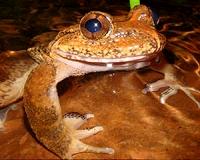 Frogs Evolution Tracks Rise Of Himalayas And Rearrangement Of Southeast Asia
Berkeley CA (SPX) Aug 12, 2010 The evolution of a group of muscled frogs scattered throughout Asia is telling geologists about the sequence of events that led to the rise of the Himalayas and the Tibetan plateau starting more than 55 million years ago. Scientists from Kunming, China, and the University of California, Berkeley, conducted a genetic analysis of 24 species of spiny frogs from the tribe Paini that shows how ... read more |
|
|
| The content herein, unless otherwise known to be public domain, are Copyright 1995-2010 - SpaceDaily. AFP and UPI Wire Stories are copyright Agence France-Presse and United Press International. ESA Portal Reports are copyright European Space Agency. All NASA sourced material is public domain. Additional copyrights may apply in whole or part to other bona fide parties. Advertising does not imply endorsement,agreement or approval of any opinions, statements or information provided by SpaceDaily on any Web page published or hosted by SpaceDaily. Privacy Statement |


 del.icio.us
 Digg
Digg Reddit
 YahooMyWeb
 Google
 Facebook


