
 |
 |
 |
 |
 |
 |
 |
 |
 |

 |

Boston MA (SPX) Jan 17, 2011 A new Chandra X-ray Observatory image of Messier 82, or M82, shows the result of star formation on overdrive. M82 is located about 12 million light-years from Earth and is the nearest place to us where the conditions are similar to those when the Universe was much younger with lots of stars forming. M82 is a so-called starburst galaxy, where stars are forming at rates that are tens or even hundreds of times higher than in a normal galaxy. The burst of star birth may be caused by a close encounter or collision with another galaxy, which sends shock waves rushing through the galaxy. In the case of M82, astronomers think that a brush with its neighbor galaxy M81 millions of years ago set off this torrent of star formation. M82 is seen nearly edge-on with its disk crossing from about 10 o'clock to about 4 o'clock in this image from Chandra (where low, medium, and high-energy X-rays are colored red, green, and blue respectively.) Among the 104 point-like X-ray sources in the image, eight so far have been observed to be very bright in X-rays and undergo clear changes in brightness over periods of weeks and years. This means they are excellent candidates to be black holes pulling material from companion stars that are much more massive than the Sun. Only a handful of such binary systems are known in the Local Group of galaxies containing the Milky Way and M31. Chandra observations are also important in understanding the rapid rate at which supernovas explode in starburst galaxies like M82. When the shock waves travel through the galaxy, they push on giant clouds of gas and dust, which causes them to collapse and form massive stars. These stars, in turn, use up their fuel quickly and explode as supernovas. These supernovas produce expanding bubbles of multimillion-degree gas that extend for millions light-years away from the galaxy's disk. These bubbles are seen as the large red areas to the upper right and lower left of the image.
Share This Article With Planet Earth
Related Links Chandra Stellar Chemistry, The Universe And All Within It

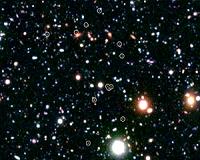 Most Distant Galaxy Cluster Identified
Pasadena CA (JPL) Jan 14, 2011 Astronomers have uncovered a burgeoning galactic metropolis, the most distant known in the early universe. This ancient collection of galaxies presumably grew into a modern galaxy cluster similar to the massive ones seen today. The developing cluster, named COSMOS-AzTEC3, was discovered and characterized by multi-wavelength telescopes, including NASA's Spitzer, Chandra and Hubble space tel ... read more |
|
|
| The content herein, unless otherwise known to be public domain, are Copyright 1995-2010 - SpaceDaily. AFP and UPI Wire Stories are copyright Agence France-Presse and United Press International. ESA Portal Reports are copyright European Space Agency. All NASA sourced material is public domain. Additional copyrights may apply in whole or part to other bona fide parties. Advertising does not imply endorsement,agreement or approval of any opinions, statements or information provided by SpaceDaily on any Web page published or hosted by SpaceDaily. Privacy Statement |


 del.icio.us
 Digg
Digg Reddit
 YahooMyWeb
 Google
 Facebook


