|
 |
 |
 |
 |
 |
 |
 |

| . |  |
. |

|
|
. |

 by Staff Writers Beijing (AFP) Sept 29, 2011
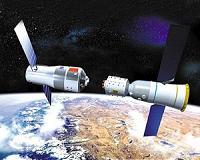
China will take its first step towards building a space station on Thursday when it launches an experimental module ahead of National Day celebrations. The Asian nation sees its ambitious space programme as a symbol of its global stature and state media said the launch of Tiangong-1, or "Heavenly Palace", represented a "milestone" for the country. Tiangong-1 is scheduled to take off between 1316 and 1331 GMT from the Gobi desert in China's northwest, propelled by a Long March 2F rocket, ahead of China's National Day on October 1. Chinese newspapers and websites splashed the planned launch across their front pages, while state-run television began counting down to the take off from early Thursday and devoted much of its coverage to the event. The unmanned 8.5-tonne module will test various space operations as a preliminary step towards building a space station by 2020. As part of that goal, Tiangong-1 -- which has a two-year lifespan in space -- will receive the unmanned Shenzhou VIII spacecraft later this year in what would be the first Chinese docking in space. If that succeeds, the module will then dock with two other spacecraft -- Shenzhou IX and X -- in 2012, both of which will have at least one astronaut on board. The technology for docking in space is hard to master because the two vessels, placed in the same orbit and revolving around Earth at some 28,000 kilometres per hour (17,360 mph), must come together progressively to avoid destroying each other. French researcher Isabelle Sourbes-Verger said that a correctly functioning docking system would put China "in a potential position to one day access the International Space Station (ISS)." But she cautioned that this was not likely to happen in the next five years. China, which has only been open to the world for some 30 years, is playing catch-up in the space arena. Just like its first manned spaceflight in 2003, the planned space docking later this year will emulate what the Americans and Russians achieved in the 1960s. China aims to finish its space station, where astronauts can live autonomously for several months like on the ISS or the former Russian Mir, by 2020. Beijing began its manned spaceflight programme in 1990, after it bought Russian technology that enabled it to become the third country to send humans into space, after the former USSR and the United States. On its national day last year, China launched its second lunar probe, Chang'e-2, and the first Chinese probe destined for Mars is due to be launched by a Russian rocket this autumn. It is unclear whether China plans to send humans to the moon, particularly after the United States said it would not return there. But the official China Daily newspaper quoted Wu Ping, a spokeswoman for China's manned space programme, as saying that the Asian nation was doing "concept research and preliminary feasibility studies on manned moon landings." She added there was currently no set timetable for such a landing. Related Links The Chinese Space Program - News, Policy and Technology China News from SinoDaily.com
|
. |
|
| The content herein, unless otherwise known to be public domain, are Copyright 1995-2011 - Space Media Network. AFP and UPI Wire Stories are copyright Agence France-Presse and United Press International. ESA Portal Reports are copyright European Space Agency. All NASA sourced material is public domain. Additional copyrights may apply in whole or part to other bona fide parties. Advertising does not imply endorsement,agreement or approval of any opinions, statements or information provided by Space Media Network on any Web page published or hosted by Space Media Network. Privacy Statement |

 del.icio.us
 Digg
Digg Reddit
 Google