|
 |
 |
 |
 |
 |
 |
 |
 |

 |

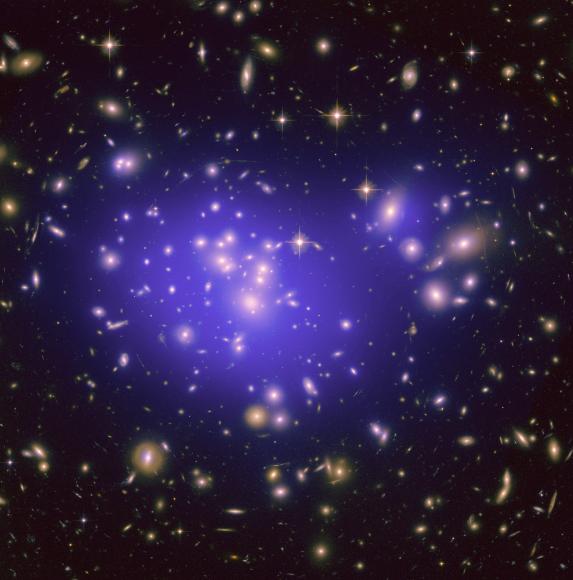
Pasadena CA (SPX) Aug 20, 2010 Astronomers have devised a new method for measuring perhaps the greatest puzzle of our universe - dark energy. This mysterious force, discovered in 1998, is pushing our universe apart at ever-increasing speeds. For the first time, astronomers using NASA's Hubble Space Telescope were able to take advantage of a giant magnifying lens in space - a massive cluster of galaxies - to narrow in on the nature of dark energy. Their calculations, when combined with data from other methods, significantly increase the accuracy of dark energy measurements. This may eventually lead to an explanation of what the elusive phenomenon really is. "We have to tackle the dark energy problem from all sides," said Eric Jullo, an astronomer at NASA's Jet Propulsion Laboratory, Pasadena, Calif. "It's important to have several methods, and now we've got a new, very powerful one." Jullo is lead author of a paper on the findings appearing in the Aug. 20 issue of the journal Science. Scientists aren't clear about what dark energy is, but they do know that it makes up a large chunk of our universe - about 72 percent. Another chunk, about 24 percent, is thought to be dark matter, also mysterious in nature but easier to study than dark energy because of its gravitational influence on matter that we can see. The rest of the universe, a mere four percent, is the stuff that makes up people, planets, stars and everything made up of atoms. In their new study, the science team used images from Hubble to examine a massive cluster of galaxies, named Abell 1689, which acts as a magnifying, or gravitational, lens. The gravity of the cluster causes galaxies behind it to be imaged multiple times into distorted shapes, sort of like a fun house mirror reflection that warps your face. Using these distorted images, the scientists were able to figure out how light from the more distant, background galaxies had been bent by the cluster - a characteristic that depends on the nature of dark energy. Their method also depends on precise ground-based measurements of the distance and speed at which the background galaxies are traveling away from us. The team used these data to quantify the strength of the dark energy that is causing our universe to accelerate. "What I like about our new method is that it's very visual," said Jullo. "You can literally see gravitation and dark energy bend the images of the background galaxies into arcs." According to the scientists, their method required multiple, meticulous steps. They spent the last several years developing specialized mathematical models and precise maps of the matter - both dark and "normal" - constituting the Abell 1689 cluster. "We can now apply our technique to other gravitational lenses," said co-author Priya Natarajan, a cosmologist at Yale University, New Haven, Conn. "We're exploiting a beautiful phenomenon in nature to learn more about the role that dark energy plays in our universe." Other authors of the paper include Jean-Paul Kneib and Carlo Schimd of the Universite de Provence, France; Anson D'Aloisio of Yale University; Marceau Limousin of Universite de Provence and University of Copenhagen, Denmark; and Johan Richard of Durham University, United Kingdom.
Share This Article With Planet Earth
Related Links JPL Stellar Chemistry, The Universe And All Within It

 AMS Experiment Takes Off For Kennedy Space Center
Geneva, Switzerland (SPX) Aug 20, 2010 The Alpha Magnetic Spectrometer (AMS), an experiment that will search for antimatter and dark matter in space, leaves CERN1 next Tuesday on the next leg of its journey to the International Space Station. The AMS detector2 is being transported from CERN to Geneva International Airport in preparation for its planned departure from Switzerland on 26 August, when it will be flown to the Kenned ... read more |
|
|
| The content herein, unless otherwise known to be public domain, are Copyright 1995-2010 - SpaceDaily. AFP and UPI Wire Stories are copyright Agence France-Presse and United Press International. ESA Portal Reports are copyright European Space Agency. All NASA sourced material is public domain. Additional copyrights may apply in whole or part to other bona fide parties. Advertising does not imply endorsement,agreement or approval of any opinions, statements or information provided by SpaceDaily on any Web page published or hosted by SpaceDaily. Privacy Statement |


 del.icio.us
 Digg
Digg Reddit
 YahooMyWeb
 Google
 Facebook