
 |
 |
 |
 |
 |
 |
 |
 |
 |

 |

London, UK (SPX) Apr 20, 2011 Whether in the present so-called 'age of austerity' or more generous times, arguing for funds for space exploration can sometimes be hard and constrained budgets mean that some excellent scientific proposals never see the light of day. On Tuesday 19 April, in his presentation at the National Astronomy Meeting in Llandudno, Wales, Leicester University astronomer Professor Martin Barstow will argue that a solution could be found in the form of low-cost space missions with a price tag of Pounds 10-20m. There is an enormous dichotomy in the costs of access to space using various methods. NASA, ESA and other space agencies have a range of satellite programmes providing mission opportunities that deliver several years of data, but with price-tags of Pounds 100M and upwards. Satellite mission opportunities occur typically at a rate of only one every 2-3 years. Therefore, responses to mission calls usually result in massive oversubscription factors and many projects simply never happen. Sub-orbital programmes through sounding rockets are more frequent and allow scientific data to be obtained for a few million pounds. However they only deliver a few minutes observing time above the atmosphere, restricting the scientific goals that can be achieved. For a typical astronomy payload, observations are limited to the brightest targets, usually one in any flight, and re-flight opportunities are quickly exhausted. Balloon programmes offer longer duration flights, up to a few days, but are only suitable for gamma-ray, visible light or infra-red studies. X-ray, extreme-UV and UV wavelength radiation emitted by astronomical objects does not penetrate far enough into the atmosphere to be detectable by instruments on balloons. Professor Barstow believes that there is an urgent need for the development of an intermediate class of mission that provides access to Low Earth Orbit (altitudes of between 160 and 2000 km) at a cost of Pounds 10M-20M, allowing a far greater number of missions than at present. One method he proposes to deliver these lower cost space missions is to re-cycle proven sub-orbital instruments, eliminating a significant proportion of the usual development expenses, and up-rating support systems such as attitude control and power to operate for several months rather than a few minutes. The UK has considerable expertise in low cost satellite technologies, for example in the company Surrey Satellite Technology Ltd (SSTL) based in Guildford, England. In his talk Professor Barstow will discuss one example of the type of instrument that could be flown at low cost, a high resolution extreme ultraviolet spectrograph (this disperses ultraviolet light from astronomical objects for analysis of properties such as temperature and composition) developed by his group. A spectrograph of this type has already flown successfully on board two sounding rocket missions. The instrument has a very simple and novel optical design delivering extraordinary efficiency compared to traditional approaches and in this case, a sensitivity greater than that of the NASA Chandra X-ray observatory is achieved in a package a fraction of the size. Professor Barstow comments: "UK space scientists are world-leading and are particularly good at making a big impact from a small budget. Low-cost space missions are a great way to get this to happen and could be a real boost for UK astronomy."
Share This Article With Planet Earth
Related Links Royal Astronomical Society Astronomy News from Skynightly.com

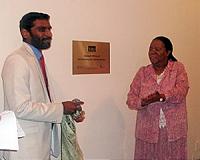 IAU Global Office Of Astronomy For Development Launched
Cape Town, South Africa (SPX) Apr 19, 2011 The South African Minister of Science and Technology, Mrs Naledi Pandor, has launched the IAU Global Office of Astronomy for Development at the headquarters of the South African Astronomical Observatory. The Global Office of Astronomy for Development (OAD) is a partnership between the IAU and the South African National Research Foundation to coordinate a wide range of worldwide activities ... read more |
|
|
| The content herein, unless otherwise known to be public domain, are Copyright 1995-2010 - SpaceDaily. AFP and UPI Wire Stories are copyright Agence France-Presse and United Press International. ESA Portal Reports are copyright European Space Agency. All NASA sourced material is public domain. Additional copyrights may apply in whole or part to other bona fide parties. Advertising does not imply endorsement,agreement or approval of any opinions, statements or information provided by SpaceDaily on any Web page published or hosted by SpaceDaily. Privacy Statement |


 del.icio.us
 Digg
Digg Reddit
 YahooMyWeb
 Google
 Facebook


