
 |
 |
 |
 |
 |
 |
 |
 |
 |

 |

Bonn, Germany (SPX) Jul 29, 2010 Is it possible that there are salt solutions on Mars that remain liquid despite the extremely low temperatures - a class of fluids known as cryobrines? Research findings at the German Aerospace Center have shown that this is a theoretical possibility. Experiments and modelling have indicated that the required conditions exist, especially during the Martian northern summer at higher latitudes. Prof. Diedrich Mohlmann of the DLR Institute of Planetary Research presented these initial findings on Friday 23 July and Saturday 24 July 2010 at the international COSPAR (Committee on Space Research) 2010 conference in Bremen. "Our research was triggered by the findings of NASA's Phoenix Mars mission," explained Prof. Mohlmann: "In 2009, scientists showed, with images of salt solution droplets on the Phoenix probe, that cryobrines could exist on Mars. Since there is no liquid water on Mars' surface, cryobrines could possibly be a fluid medium that supports life." Prof. Mohlmann and his team have discovered that it is possible for the liquefaction of cryobrines during the northern summer at high northern latitudes to last all day. At middle latitudes, the phenomenon occurs over several hours during the morning and evening; this is due to the salts absorbing atmospheric humidity to liquefy - a process known to as deliquescence. A higher degree of humidity prevails during the northern summer, which declines further south.
Encouraging results This liquid solution could allow flow processes, known as rheological processes, on the Martian surface. In the context of possible biological processes, this could also be a life-sustaining transport of nutrition and waste. These are all qualities that are normally only attributed to water. The question of whether this is sufficient to make life possible is being investigated in the next phase by microbiologists at the Technical University of Berlin together with colleagues from the DLR Institute of Planetary Research. If life is possible in these temporary liquid salt solutions, the definition of habitability will need to be expanded: 'Pure' water would no longer be the sole prerequisite for the emergence of life. The DLR and TU Berlin research teams are experimenting with these biological questions within the framework of 'Planetary Evolution and Life', an alliance of the Helmholtz Association. "We are still at the beginning, but our initial findings are extremely encouraging," declared Prof. Mohlmann, and he continued: "We are currently testing various micro-organisms to examine whether and how they survive in salt solutions. Under terrestrial conditions - that is, with a freezing point of zero degrees Celsius, this has been already explored, but not at temperatures below zero."
Share This Article With Planet Earth
Related Links German Aerospace Center (DLR) Mars News and Information at MarsDaily.com Lunar Dreams and more

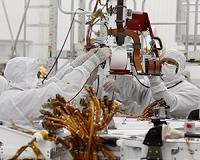 Curiosity Rover Grows By Leaps And Bounds
Pasadena CA (JPL) Jul 26, 2010 Talk about a growth-spurt. In one week, Curiosity grew by approximately 1 meter (3.5 feet) when spacecraft technicians and engineers attached the rover's neck and head (called the Remote Sensing Mast) to its body. At around 2 meters (about 7 feet) tall, the next rover to Mars now stands head and shoulders above the rest. Mounted on Curiosity's mast are two navigation cameras (Navcams), two ... read more |
|
|
| The content herein, unless otherwise known to be public domain, are Copyright 1995-2010 - SpaceDaily. AFP and UPI Wire Stories are copyright Agence France-Presse and United Press International. ESA Portal Reports are copyright European Space Agency. All NASA sourced material is public domain. Additional copyrights may apply in whole or part to other bona fide parties. Advertising does not imply endorsement,agreement or approval of any opinions, statements or information provided by SpaceDaily on any Web page published or hosted by SpaceDaily. Privacy Statement |


 del.icio.us
 Digg
Digg Reddit
 YahooMyWeb
 Google
 Facebook


