
 |
 |
 |
 |
 |
 |
 |
 |
 |

 |

Paris, France (SPX) Sep 21, 2010 A new golden age of sailing may be about to begin - in space. Future missions to explore the outer planets could employ fleets of 'data-clippers', maneuverable spacecraft equipped with solar sails, to ship vast quantities of scientific data to back Earth. According to Joel Poncy of Thales Alenia Space, the technology could be ready in time to support mid-term missions to the moons of Jupiter and Saturn. Poncy will be presenting an assessment of data clippers at the European Planetary Science Congress in Rome on Monday 20th September. "Space-rated flash memories will soon be able to store the huge quantities of data needed for the global mapping of planetary bodies in high resolution. But a full high-res map of, say, Europa or Titan, would take several decades to download from a traditional orbiter, even using very large antennae. Downloading data is the major design driver for interplanetary missions. We think that data clippers would be a very efficient way of overcoming this bottleneck," said Poncy. Poncy and his team at Thales Alenia Space have carried out a preliminary assessment for a data clipper mission. Their concept is for a clipper to fly close to a planetary orbiter, upload its data and fly by Earth, at which point terabytes of data could be downloaded to the ground station. A fleet of data clippers cruising around the Solar System could provide support for an entire suite of planetary missions. "We have looked at the challenges of a data clipper mission and we think that it could be ready for a launch in the late 2020s. This means that the technology should be included now in the roadmap for future missions, and this is why we are presenting this study at EPSC," said Poncy. Poncy's team have assessed the communications systems and tracking devices that a data clipper would need, as well as the flyby conditions and pointing accuracy required for the massive data transfers. Recent advances in technology mean that spacecraft propelled by solar sails, which use radiation pressure from photons emitted by the Sun, or electric sails, which harness the momentum of the solar wind, can now be envisaged for mid-term missions. The Japanese Space Agency, JAXA, is currently testing a solar sail mission, IKAROS. "Using the Sun as a propulsion source has the considerable advantage of requiring no propellant on board. As long as the hardware doesn't age too much and the spacecraft is maneuverable, the duration of the mission can be very long. The use of data clippers could lead to a valuable downsizing of exploration missions and lower ground operation costs - combined with a huge science return. "The orbiting spacecraft would still download some samples of their data directly to Earth to enable real-time discoveries and interactive mission operations. But the bulk of the data is less urgent and is often processed by scientists much later. Data clippers could provide an economy delivery service from the outer Solar System, over and over again," said Poncy.
Share This Article With Planet Earth
Related Links Thales Alenia Space Space Tourism, Space Transport and Space Exploration News

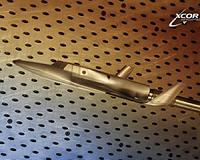 XCOR Completes Lynx Supersonic Wind Tunnel Tests
Mojave CA (SPX) Sep 21, 2010 XCOR Aerospace has announced they have completed the primary supersonic wind tunnel testing of the Lynx suborbital spacecraft. The tests were performed at NASA Marshall Space Flight Center (MSFC) using a precision scale model and demonstrated the integrity of the Lynx aerodynamic shape and provided data to make final refinements to the vehicle. These new data provide confidence that the Ly ... read more |
|
|
| The content herein, unless otherwise known to be public domain, are Copyright 1995-2010 - SpaceDaily. AFP and UPI Wire Stories are copyright Agence France-Presse and United Press International. ESA Portal Reports are copyright European Space Agency. All NASA sourced material is public domain. Additional copyrights may apply in whole or part to other bona fide parties. Advertising does not imply endorsement,agreement or approval of any opinions, statements or information provided by SpaceDaily on any Web page published or hosted by SpaceDaily. Privacy Statement |


 del.icio.us
 Digg
Digg Reddit
 YahooMyWeb
 Google
 Facebook


