|
 |
 |
 |
 |
 |
 |
 |

| . |  |
. |

|
|
. |

 by Staff Writers Washington DC (SPX) Sep 19, 2011
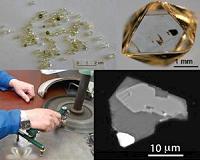
Scientists have speculated for some time that the Earth's carbon cycle extends deep into the planet's interior, but until now there has been no direct evidence. The mantle-Earth's thickest layer -is largely inaccessible. A team of researchers analyzed diamonds that originated from the lower mantle at depths of 435 miles (700 kilometers) or more, and erupted to the surface in volcanic rocks called kimberlites. The diamonds contain what are impurities to the gemologist, but are known as mineral inclusions to the geologist. Analysis shows compositions consistent with the mineralogy of oceanic crust. This finding is the first direct evidence that slabs of oceanic crust sank or subducted into the lower mantle and that material, including carbon, is cycled between Earth's surface and depths of hundreds of miles. The research is published in the September 15, 2011, online Science Express. The mantle extends from as little as 5 to 1,800 miles (10-2,900 kilometers) beneath the Earth's surface. Most diamonds are free from inclusions and come from depths less than 120 miles (200 km). But in a few localities researchers have found super-deep diamonds from the depths of the convecting upper and lower mantle, as well as the transition zone in between. Whereas inclusions in diamonds from the depths of the upper mantle and transition zone have been consistent with a surface-rock origin, none from the lower mantle have borne this signature until now. The team,* which included Carnegie scientists, was led by former Carnegie postdoctoral fellow Michael Walter, now a professor at the University of Bristol, UK. The scientists analyzed minute (one to two hundredths of a millimeter) mineral grains from six diamonds from the Juina region in Brazil. The analysis showed that diamond inclusions initially crystallized as a single mineral that could form only at depths greater than 435 miles (700 km). But the inclusions recrystallized into multiple minerals as they were carried up to the surface-first probably from a mantle upwelling known as a plume, then as they erupted to the surface in kimberlites The diamonds were analyzed for carbon at Carnegie. Four of the diamonds contained low amounts of carbon-13, a signature not found in the lower mantle and consistent with an ocean-crust origin at Earth's surface. "The carbon identified in other super-deep, lower mantle diamonds is chiefly mantle-like in composition," remarked co-author Steven Shirey * at Carnegie. "We looked at the variations in the isotopes of the carbon atoms in the diamonds. Carbon originating in a rock called basalt, which forms from lava at the surface, is often different from that which originates in the mantle, in containing relatively less carbon-13. These super-deep diamonds contained much less carbon-13, which is most consistent with an origin in the organic component found in altered oceanic crust." "I find it astonishing that we can use the tiniest of mineral grains to show some of the motions of the Earth's mantle at the largest scales," concluded Shirey. The researchers on the paper are M.J. Walter, S. Kohn, G. Bulanova, and C. Smith of University of Bristol, UK; D. Araujo of Universidade de Brasilia-DF Brazil; A. Steele of Carnegie's Geophysical Laboratory, and S. Shirey, E. Gaillou, and J. Wang of Carnegie's Department of Terrestrial Magnetism. Funding was provided by the NSF in the US, the National Environmental Research Council (NERC) in the UK, and the Carnegie Institution for Science. Related Links Carnegie Institution Carbon Worlds - where graphite, diamond, amorphous, fullerenes meet
|
. |
|
| The content herein, unless otherwise known to be public domain, are Copyright 1995-2011 - Space Media Network. AFP and UPI Wire Stories are copyright Agence France-Presse and United Press International. ESA Portal Reports are copyright European Space Agency. All NASA sourced material is public domain. Additional copyrights may apply in whole or part to other bona fide parties. Advertising does not imply endorsement,agreement or approval of any opinions, statements or information provided by Space Media Network on any Web page published or hosted by Space Media Network. Privacy Statement |

 del.icio.us
 Digg
Digg Reddit
 Google