
 |
 |
 |
 |
 |
 |
 |
 |
 |

 |

Canberra, Australia (SPX) May 13, 2011 A review of the potential benefits and risks associated with the Australian Government's proposed Carbon Farming Initiative (CFI) features in the April-May edition (160) of CSIRO's ECOS magazine. The CFI aims to enable Australian farmers to reduce greenhouse gas emissions and generate tradeable carbon credits. The agricultural sector accounts for over a quarter of the nation's total annual greenhouse gas emissions. It also offers significant opportunities for emissions reductions through tree conservation and planting, improved land management, and new technology. Challenges facing the CFI include effective codes of practice - for example, ensuring carbon remains locked up in 'carbon forest' plantations for at least 100 years. Carbon can also be locked up in soil. CSIRO's Dr Jeff Baldock says land clearing and agriculture in Australia have resulted in losses of 20-70 per cent of soil carbon, compared with undisturbed areas. "This has created an opportunity for farmers to rebuild soil carbon," Dr Baldock says. If the CFI bill is passed by Parliament, it will become the world's first legislated mechanism for generating carbon credits from farm projects. ECOS 160 also reports on technological developments in the area of concentrating solar thermal (CST) power generation, which will enable solar plants to supply mains power in all weather and around the clock. According to CSIRO's Dr Jim Smitham, Australia's interest in the potential of CST has been led by CSIRO for more than a decade. "As well investigating standalone CST, CSIRO is investigating hybrid solar/fossil fuel and solar/geothermal plan combinations, including solar-assisted gas turbine or high-temperature steam support for fossil fuel power stations to achieve greater thermal efficiency at lower cost," Dr Smitham said. In a feature article, CSIRO researcher Dr Joely Taylor provides an insight into Australia's prospects of developing a sustainable biofuels industry from waste biomass. "A home-grown, waste-fed, 'second-generation' biofuels market would provide environmental, economic and fuel security benefits for Australia. "Second-generation technologies - many of which are now reaching the commercial demonstration stage - convert waste materials like wheat chaff, cane bagasse, forestry residues and urban waste diverted from landfill," Dr Taylor says. "This reduces the competition for arable land - a problem posed by first-generation, crop-based biofuels. In another article ECOS investigates a controversial idea for helping conserve native plants and animals threatened by climate change by relocating them to areas outside their known range. CSIRO's Dr Tara Martin says fossil evidence indicates some species, such as the mountain pygmy possum, were once found in areas outside their normal distribution. Although managed relocation of species in the face of other threats - such as feral predators or disease - is not new, climate change presents a new set of challenges, such as whether the species might be able to adapt to climate impacts. "However, while managed relocation will be used in some specific circumstances for species we really value, it will not be a saviour for all biodiversity in the face of climate change," Dr Martin says.
Share This Article With Planet Earth
Related Links ECOS Climate Science News - Modeling, Mitigation Adaptation

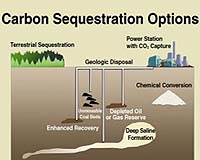 Chemistry curbs spreading of carbon dioxide
Cambridge UK (SPX) May 11, 2011 The presence of even a simple chemical reaction can delay or prevent the spreading of stored carbon dioxide in underground aquifers, new research from the University of Cambridge has revealed. The findings may have implications for carbon sequestration in saline aquifers - one of the many methods being explored to mitigate rising CO2 levels in the atmosphere. Depending on the strengt ... read more |
|
|
| The content herein, unless otherwise known to be public domain, are Copyright 1995-2010 - SpaceDaily. AFP and UPI Wire Stories are copyright Agence France-Presse and United Press International. ESA Portal Reports are copyright European Space Agency. All NASA sourced material is public domain. Additional copyrights may apply in whole or part to other bona fide parties. Advertising does not imply endorsement,agreement or approval of any opinions, statements or information provided by SpaceDaily on any Web page published or hosted by SpaceDaily. Privacy Statement |


 del.icio.us
 Digg
Digg Reddit
 YahooMyWeb
 Google
 Facebook


