
 |
 |
 |
 |
 |
 |
 |
 |
 |

 |

Gainesville FL (SPX) Nov 02, 2010 New University of Florida research puts to rest the mystery of where old carbon was stored during the last glacial period. It turns out it ended up in the icy waters of the Southern Ocean near Antarctica. The findings have implications for modern-day global warming, said Ellen Martin, a UF geological sciences professor and an author of the paper, which is published in this week's journal Nature Geoscience. "It helps us understand how the carbon cycle works, which is important for understanding future global warming scenarios," she said. "Ultimately, a lot of the carbon dioxide that we're pumping into the atmosphere is going to end up in the ocean. By understanding where that carbon was stored in the past and the pathways it took, we develop a better understanding of how much atmospheric carbon dioxide the oceans can absorb in the future." Scientists know that during the transition from the last glacial period to the current inter-glacial period about 14,000 years ago, carbon dioxide levels rose very quickly at the same time that the age of the carbon dioxide in the atmosphere fell, as measured by radiocarbon data. That suggests carbon dioxide had been stored in the ocean and suddenly released, she said. One idea holds that it was building up in the Southern Ocean around Antarctica, where extensive sea ice on the surface of the ocean initially prevented the exchange of gasses into the atmosphere, Martin said. The other possibility is that the same process occurred in the Northern Hemisphere with ice sheets in the North Pacific Ocean, she said. In her lab, Martin and lead author Chandranath Basak, a UF graduate student in geological sciences; Keiji Horikawa, a UF postdoctoral fellow in geological sciences; and Thomas Marchitto, a University of Colorado geology professor, studied that question by using a technique to measure isotopes of neodymium, a rare earth element not commonly found in marine sediments but preserved in microscopic fossil fish teeth. The isotopic signature of a water mass, which is captured in the fish teeth, reflects the location where the water mass came from, she said. "It's essentially what we call a water mass tracer," Martin said. "You can tell where the water masses have formed and where they have moved to by using this tracer." The researchers took samples that had been shown to have old carbon in them and measured the neodymium isotopes on fish teeth from the sediments to see if they could reconstruct whether they had come from the North Pacific or the Southern Ocean, she said. "When we did this, we got a signal that looks very much like the Southern Ocean," she said. "It implies that all the carbon was being stored in the Southern Hemisphere and as the ice sheet melted back, it released that carbon dioxide into the atmosphere, causing part of the big increase in carbon dioxide and introducing old carbon back into the atmosphere." By giving information about environmental conditions during the last glacial period, the research findings can help scientists to reconstruct what the world was like at that time, she said. The implications are that while large amounts of carbon could be stored in the ocean when there was a great deal of sea ice, the opposite is the case in a world that is warming, with less ice, which allows more carbon dioxide to be released into the atmosphere, Martin said. Thus, in a warming scenario the oceans may not be able to store as much carbon dioxide as they could under glacial conditions. The oceans are a critical part of the carbon dioxide cycle, Martin said. "The oceans have 60 times more carbon dioxide in them than the atmosphere, so when we worry about what's happening with carbon dioxide in the atmosphere, we often look to the oceans as a potential source or sink." The concentration of carbon dioxide in the atmosphere during the glacial periods was about 200 parts per million, compared with 280 parts per million during a typical interglacial period, Martin said. Today that level has soared to about 380 parts per million, she said. The time period that encompasses the last glacial period to the current interglacial period when carbon dioxide levels went up very quickly is often referred to as the "mystery interval" because scientists hadn't known where the carbon was stored, Martin said. "Now we have a better understanding of how the system worked," she said.
Share This Article With Planet Earth
Related Links University of Florida Beyond the Ice Age

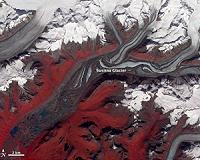 Susitna Glacier, Alaska
Greenbelt MD (SPX) Oct 22, 2010 Like rivers of liquid water, glaciers flow downhill, with tributaries joining to form larger rivers. But where water rushes, ice crawls. As a result, glaciers gather dust and dirt, and bear long-lasting evidence of past movements. Alaska's Susitna Glacier revealed some of its long, grinding journey when the Advanced Spaceborne Thermal Emission and Reflection Radiometer (ASTER) on NASA's Te ... read more |
|
|
| The content herein, unless otherwise known to be public domain, are Copyright 1995-2010 - SpaceDaily. AFP and UPI Wire Stories are copyright Agence France-Presse and United Press International. ESA Portal Reports are copyright European Space Agency. All NASA sourced material is public domain. Additional copyrights may apply in whole or part to other bona fide parties. Advertising does not imply endorsement,agreement or approval of any opinions, statements or information provided by SpaceDaily on any Web page published or hosted by SpaceDaily. Privacy Statement |


 del.icio.us
 Digg
Digg Reddit
 YahooMyWeb
 Google
 Facebook


