
 |
 |
 |
 |
 |
 |
 |
 |
 |

 |

Leeds, UK (SPX) Aug 13, 2010 Time for a quick cuppa? When the final whistle blows, demand for electricity usually soars, causing a headache for energy companies. Researchers at the University of Leeds and the Chinese Academy of Sciences have now found a way to manage these short-lived draws on the electricity grid that could halve the fuel needed. The amount of electricity drawn from the national grid varies enormously at different times of day. It usually peaks in the early evening for a couple of hours after the mass exodus from school and work. Short-lived spikes are also common after major televised sporting events, during commercial breaks and in the morning hours. But matching the highs and lows in demand with a steady supply is a major challenge. Energy companies typically top up a 'base' supply of energy with electricity from power plants that are just switched on to cope with the peaks. However, the gas-fired generators often used to feed these peaks are notoriously inefficient, expensive to run and sit idle for long periods of time. In short, the system wastes both energy and resources. University of Leeds Professor of Engineering, Yulong Ding, and colleagues are proposing a more environmentally friendly system that would also be cheaper to run. Crucially, the system would store excess energy made by a plant supplying the 'base' demand and use this to supply the 'peaks' in demand - as and when they happen. "This integrated system is truly novel," said Professor Ding, who led the research. "Because we are storing the excess energy for later, there is less need to ramp up the output of gas-fired plants whenever a peak in demand is expected, generating electricity that may simply not be used." The key idea is to use excess electricity to run a unit producing liquid nitrogen and oxygen - or 'cryogen'. At times of peak demand, the nitrogen would be boiled - using heat from the environment and waste heat from the power plant. The hot nitrogen gas would then be used to drive a turbine or engine, generating 'top up' electricity. Meanwhile, the oxygen would be fed to the combustor to mix with the natural gas before it is burned. Burning natural gas in pure oxygen, rather than air, makes the combustion process more efficient and produces less nitrogen oxide. Instead, this 'oxy-fuel' combustion method produces a concentrated stream of carbon dioxide that can be removed easily in solid form as dry ice. Using such an integrated system, the amount of fuel needed to cater for peak demand could be cut by as much as 50%. Greenhouse gas emissions would be lower too, thanks to the greatly reduced nitrogen oxide emissions and the capture of carbon dioxide gas in solid form for storage. "This is a much better way of dealing with these peaks in demand for electricity. Greenhouse gas emissions would also be cut considerably because the carbon dioxide generated in the gas-fired turbine would be captured in solid form." "On paper, the efficiency savings are considerable. We now need to test the system in practice," Professor Ding said. Full details of the system will be published in the International Journal of Energy Research.
Share This Article With Planet Earth
Related Links University of Leeds Powering The World in the 21st Century at Energy-Daily.com

 Canada clean energy creating 1,400 jobs
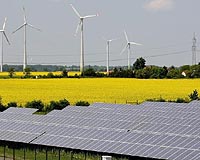
Ottawa (UPI) Aug 12, 2010 Canada's latest forays into clean energy projects for solar and wind power generation are set to create 1,400 jobs that are a small part of a 50,000-job target in the green energy sector. The 1,400 jobs will be created as Ontario's first wind turbine blade manufacturing plant and a solar module manufacturing facility get going, officials said. Together the projects will serve Ontario's ... read more |
|
|
| The content herein, unless otherwise known to be public domain, are Copyright 1995-2010 - SpaceDaily. AFP and UPI Wire Stories are copyright Agence France-Presse and United Press International. ESA Portal Reports are copyright European Space Agency. All NASA sourced material is public domain. Additional copyrights may apply in whole or part to other bona fide parties. Advertising does not imply endorsement,agreement or approval of any opinions, statements or information provided by SpaceDaily on any Web page published or hosted by SpaceDaily. Privacy Statement |


 del.icio.us
 Digg
Digg Reddit
 YahooMyWeb
 Google
 Facebook


