
 |
 |
 |
 |
 |
 |
 |
 |
 |

 |

London UK (SPX) Nov 17, 2010 Variations in atmosphere carbon dioxide around 40 million years ago were tightly coupled to changes in global temperature, according to new findings published in the journal Science. The study was led by scientists at Utrecht University, working with colleagues at the NIOZ Royal Netherlands Institute for Sea Research and the University of Southampton. "Understanding the relationship between the Earth's climate and atmospheric carbon dioxide in the geological past can provide insight into the extent of future global warming expected to result from carbon dioxide emission caused by the activities of humans," said Dr Steven Bohaty of the University of Southampton's School of Ocean and Earth Science (SOES) based at the National Oceanography Centre in Southampton. It has been known for some time that the long-term warmth of the Eocene (~56 to 34 million yearsago) was associated with relatively high atmospheric carbon dioxide levels. However, scientists were previously unable to demonstrate tight-coupling between variations in atmospheric carbon dioxide and shorter-term changes in global climate. To fill this gap in knowledge, the authors of the new study focused on one of the hottest episodes of Earth's climate history - the MiddleEocene Climatic Optimum (MECO), which occurred around 40 million years ago. Algae use photosynthesis to harvest the energy of the sun, converting carbon dioxide and water into the organic molecules required for growth. Different isotopes of carbon are incorporated into these molecules depending on the environmental conditions under which algae grow. Ancient climate can therefore be reconstructed by analysing the carbon isotope ratios of molecules preserved in fossilised algae. The researchers took this approach to reconstruct variations in carbon dioxide levels across the MECO warming event, using fossilised algae preserved in sediment cores extracted from the seafloor near Tasmania, Australia, by the Ocean Drilling Program. They refined their estimates of carbon dioxide levels usinginformation on the past marine ecosystem derived from studying changes in the abundance of different groups of fossil plankton. Their analyses indicate that MECO carbon dioxide levels must have at least doubled over a period of around 400,000 years. In conjunction with these findings, analyses using two independent molecular proxies for sea surface temperature show that the climate warmed by between 4 and 6 degrees Celsius over the same period. "We found a close correspondence between carbon dioxide levels and sea surface temperature over the whole period, suggesting that increased amounts of carbon dioxide in the atmosphere played amajor role in global warming during the MECO," said Bohaty. The researchers consider it likely that elevated atmospheric carbon dioxide levels during the MECO resulted in increased global temperatures, rather than vice versa, arguing that the increase in carbon dioxide played the lead role. "The change in carbon dioxide 40 million years ago was too large to have been the result of temperature change and associated feedbacks," said co-lead author Peter Bijl of Utrecht University. "Such a large change in carbon dioxide certainly provides a plausible explanation for the changes in Earth's temperature." The researchers point out that the large increase in atmospheric carbon dioxide indicated by their analysis would haverequired a natural carbonsource capable of injecting vast amounts of carbon into theatmosphere. The rapid increase in atmospheric carbon dioxide levels around 40 million years ago approximately coincides with the rise of the Himalayas and may be related to the disappearance of an ocean between India and Asia as a result of plate tectonics - the large scale movements of the Earth's rocky shell (lithosphere). But, as explained by Professor Paul Pearson of Cardiff University in a perspective article accompanying the Science paper, the hunt is now on to discover the exact cause. The researchers are Peter Bijl, Alexander Houben, Appy Sluijs, Henk Brinkhuis, Gert-Jan Reichart (Utrecht University), Jaap Sinninghe Damste and Stefan Schouten (NIOZ Royal Netherlands Institute of Sea Research), and Steven Bohaty (SOES). The research was funded by the Netherlands Organization for Scientific Research Utrecht University and Statoil, and used samples and data provided by the Ocean Drilling Program (ODP). Publication: Bijl, P. K., Houben, A. J. P., Schouten, S., Bohaty, S. M., Sluijs, A., Reichart, G-J.,Sinninghe Damste, J. S. and Brinkhuis, H. Transient middle Eocene atmospheric CO2and temperature variations.Science 330, 819 - 8215 (2010). DOI: 10.1126/science.1193654
Share This Article With Planet Earth
Related Links Utrecht University Explore The Early Earth at TerraDaily.com

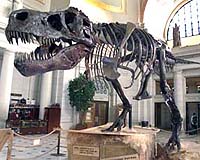 Big Tail Was Key To Speed And Hunting Prowess Of T Rex
Edmonton, Canada (SPX) Nov 16, 2010 Tyrannosaurus rex was far from a plodding Cretaceous era scavenger whose long tail only served to counterbalance the up-front weight of its freakishly big head. T. rex's athleticism (and its rear end) has been given a makeover by University of Alberta graduate student Scott Persons. His extensive research shows that powerful tail muscles made the giant carnivore one of the fastest moving h ... read more |
|
|
| The content herein, unless otherwise known to be public domain, are Copyright 1995-2010 - SpaceDaily. AFP and UPI Wire Stories are copyright Agence France-Presse and United Press International. ESA Portal Reports are copyright European Space Agency. All NASA sourced material is public domain. Additional copyrights may apply in whole or part to other bona fide parties. Advertising does not imply endorsement,agreement or approval of any opinions, statements or information provided by SpaceDaily on any Web page published or hosted by SpaceDaily. Privacy Statement |


 del.icio.us
 Digg
Digg Reddit
 YahooMyWeb
 Google
 Facebook


