|
 |
 |
 |
 |
 |
 |
 |

| . |  |
. |

|
|
. |

 by Staff Writers Buffalo NY (SPX) Jul 20, 2011
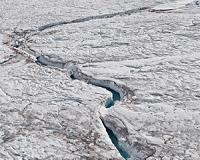
Large, marine-calving glaciers have the ability not only to shrink rapidly in response to global warming, but to grow at a remarkable pace during periods of global cooling, according to University at Buffalo geologists working in Greenland. The conclusion stems from new research on Jakobshavn Isbrae, a tongue of ice extending out to sea from Greenland's west coast. Through an analysis of adjacent lake sediments and plant fossils, the UB team determined that the glacier, which retreated about 40 kilometers inland between 1850 and 2010, expanded outward at a similar pace about 200 years ago, during a time of cooler temperatures known as the Little Ice Age. A paper detailing the results is in press and available online in Quaternary Science Reviews, a top peer-reviewed journal in the field. "We know that Jakobshavn Isbrae has retreated at this incredible rate in recent years, and our study suggests that it advanced that fast, also," said Jason Briner, the associate professor of geology who led the research. His team included master's and PhD students from UB and Brown University. "Our results support growing evidence that calving glaciers are particularly sensitive to climate change," Briner added. Jakobshavn Isbrae has been the focus of intense scientific interest because it is one of the world's fastest-flowing glacier, releasing enormous quantities of Greenland's ice into the ocean. Changes in the rate at which icebergs calve off from the glacier could influence global sea level rise. The decline of Jakobshavn Isbrae between 1850 and 2010 has been well-documented through aerial photographs and satellite photographs by UB Associate Professor of Geology Bea Csatho, which show the ice shrinking rapidly from west to east along a narrow fjord. To reconstruct the glacier's advance from east to west during earlier, cooler years, Briner and his colleagues examined sediment samples from Glacial Lake Morten and Iceboom Lake, two glacier-fed lakes that sit along the glacier's path of expansion. As Jakobshavn Isbrae expanded seaward, it reached Glacial Lake Morten first, damming one side of the lake with ice and filling the basin, previously a tundra-covered valley, with meltwater. To pinpoint the time in history when this happened, the researchers counted annual layers of overlying glacial sediments and used radiocarbon dating to analyze plant fossils at the lake bottom (the last vestiges of the old tundra). The team's conclusion: Glacial Lake Morten formed between 1795 and 1800. An analysis of sediment layers from the bottom of Iceboom Lake showed that Jakobshavn Isbrae reached Iceboom lake about 20 or 25 years later, around 1820. Jakobshavn Isbrae's rate of expansion from Glacial Lake Morten to Iceboom Lake, as documented by the UB team, matched the glacier's rate of retreat between those two points. (Aerial imagery shows Iceboom Lake draining around 1965 and Glacial Lake Morten draining between 1986 and 1991.) Briner's research was funded by the National Science Foundation's Geography and Spatial Sciences Program.
|
. |
|
| The content herein, unless otherwise known to be public domain, are Copyright 1995-2011 - Space Media Network. AFP and UPI Wire Stories are copyright Agence France-Presse and United Press International. ESA Portal Reports are copyright European Space Agency. All NASA sourced material is public domain. Additional copyrights may apply in whole or part to other bona fide parties. Advertising does not imply endorsement,agreement or approval of any opinions, statements or information provided by Space Media Network on any Web page published or hosted by Space Media Network. Privacy Statement |

 del.icio.us
 Digg
Digg Reddit
 Google