|
|
|
|
|
|
|
|
|
|
|


| . |  |
. |
|
|
|
 by Alan Delamere and Alfred McEwen Tucson AZ (SPX) Oct 07, 2013
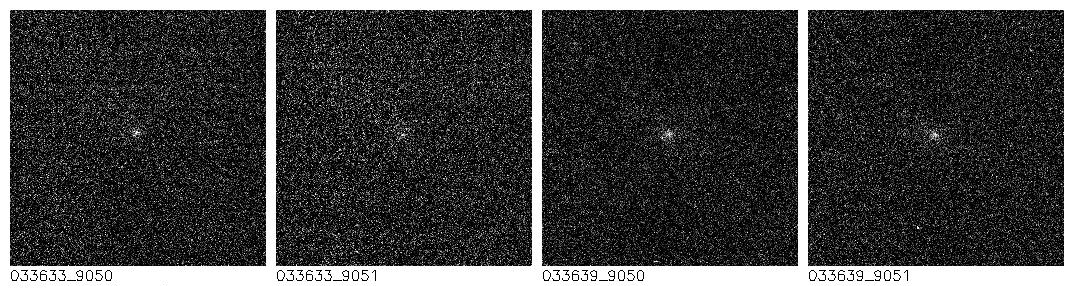
On 29 September 2013, the Mars Reconnaissance Orbiter (MRO) maneuvered to point its High Resolution Imaging Science Experiment (HiRISE) camera at ISON, a new comet passing by Mars on its way into the inner Solar System. HiRISE saw a small spot at the position of ISON that is relatively bright, like a star, but moving relative to actual stars. The comet's coma is apparently very faint, so these data provide useful constraints on the size of the comet nucleus and its overall brightness, key measurements to understand its behavior and useful knowledge to subsequent observers. These images show a 256 x 256 pixel patch of sky at the range to the comet of 8 million miles and when the solar phase angle is 47 degrees. Three more observations of ISON are planned for 1 and 2 October as the comet moves through closest approach to Mars at 7 million miles, but with less illumination as seen from Mars. Based on preliminary analysis of the data, the comet appears to be at the low end of the range of brightness predictions for the observation. As a result, the image isn't visually pleasing but low coma activity is best for constraining the size of the nucleus. This image has a scale of approximately 8 miles (13.3 km) per pixel, larger than the comet, but the size of the nucleus can be estimated based on the typical brightness of other comet nuclei. The comet, like Mars, is currently 241 million kilometers from the Sun. As the comet gets closer to the sun, its brightness will increase to Earth-based observers and the comet may also become intrinsically brighter as the stronger sunlight volatilizes the comet's ices. Comet ISON (officially known as C/2012 S1) is believed to be in its first pass through the inner solar system from the distant Oort Cloud, a roughly spherical collection of comets and comet-like structures that exists in a space between one-tenth light-year and 1 light-year from the sun. The comet will pass within 724,000 miles (1.16 million kilometers) of the Sun on 28 November 2013. It was discovered on 21 September 2012, roughly between Jupiter and Saturn, by Vitali Nevski and Artyom Novichonok at the International Scientific Optical Network (ISON) near Kislovodsk, Russia.
Related Links University of Arizona Asteroid and Comet Mission News, Science and Technology
|
|
|
| The content herein, unless otherwise known to be public domain, are Copyright 1995-2014 - Space Media Network. AFP, UPI and IANS news wire stories are copyright Agence France-Presse, United Press International and Indo-Asia News Service. ESA Portal Reports are copyright European Space Agency. All NASA sourced material is public domain. Additional copyrights may apply in whole or part to other bona fide parties. Advertising does not imply endorsement,agreement or approval of any opinions, statements or information provided by Space Media Network on any Web page published or hosted by Space Media Network. Privacy Statement |

 del.icio.us
 Digg
Digg Reddit
 Google