
 |
 |
 |
 |
 |
 |
 |
 |
 |

 |

Rome, Italy (SPX) Sep 24, 2010 The Herschel Space Observatory is providing its first results on Mars. An accurate globally-averaged temperature profile of the Martian atmosphere may cause scientists to revise their models about atmospheric circulation on Mars. The first sub-millimeter observation of molecular oxygen on the planet may lead to a completely new picture of the oxygen distribution in the Martian atmosphere. These are only a few of the new discoveries presented by Dr. Paul Hartogh at the European Planetary Science Congress in Rome. The Herschel Space Observatory (HSO) is a space-borne far-infrared observation facility of the European Space Agency, launched on 14 May 2009. The 'Water and related chemistry in the Solar System' project, was conceived with the sole aim to determine the origin, evolution, and distribution of water in Mars, the outer planets, Titan, Enceladus and the comets. "Water vapor plays a key role in the Martian atmospheric chemistry and physics," says Dr. Hartogh of the Max Planck Institute for Solar System Research in Germany. Herschel has observed Mars with its three instruments, the Heterodyne Instrument for the Far Infrared (HIFI), the Photodetector Array Camera and Spectrometer, and the Spectral and Photometric Imaging Receiver (SPIRE). SPIRE has provided the first continuous spectrum of the Martian atmosphere in the spectral range in the far-IR/sub-mm, as well as, the first complete set of water vapor and carbon monoxide (CO) content in this range. "SPIRE was designed for very faint sources, however unexpectedly it could even provide high quality data from the brightest far infrared object Herschel observed in the solar system," says Dr. Hartogh. HIFI observed Mars between 11-16 April 2010. Only a small part of the data has been analyzed up to now, but it already provided some interesting results: A globally averaged temperature profile has been retrieved from the first simultaneous observations of two carbon monoxide isotopes. "The best fit of the Martian atmospheric model to these observations shows important differences compared to what we were predicting: between 40 and 80 km from the ground, the atmosphere appears to be more than 10 degrees Celsius colder than predicted," says Dr. Hartogh. Scientists also report on the first sub-mm detection of molecular oxygen (O2) on Mars, with an observational accuracy at least 10 times better than was done before. "Our sub-mm observations provide for the first time a vertical profile of molecular oxygen in the Martian atmosphere. We found that, contrary to the general assumption of a constant O2 content independently of altitude, the Martian atmosphere is richer in oxygen near the ground and then O2 decreases rapidly with altitude," says Dr. Hartogh. If this profile is confirmed it may imply different oxygen production and loss processes not considered before, leading to new insights about the Martian atmosphere. "Obviously, much work still needs to be done on the vertical profile of O2 before we draw such conclusions," he adds cautiously. Herschel will continue exploring our solar system in the next 2-3 years of its planned mission duration. "We hope that surprises and major breakthroughs in our knowledge will keep coming in, and that at the end we will have gained a unified picture of the origin and evolution of water in the Solar System objects," says Dr. Hartogh.
Share This Article With Planet Earth
Related Links EPSC 2010 Mars News and Information at MarsDaily.com Lunar Dreams and more

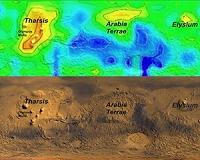 Mars Methane Lasts Less Than A Year
Pasadena CA (SPX) Sep 23, 2010 Methane in the atmosphere of Mars lasts less than a year, according to a study by Italian scientists. Sergio Fonti (Universita del Salento) and Giuseppe Marzo (NASA Ames) have used observations from NASA's Mars Global Surveyor spacecraft to track the evolution of the gas over three martian years. They presented their results at the European Planetary Science Congress in Rome on Tuesday 21st Sept ... read more |
|
|
| The content herein, unless otherwise known to be public domain, are Copyright 1995-2010 - SpaceDaily. AFP and UPI Wire Stories are copyright Agence France-Presse and United Press International. ESA Portal Reports are copyright European Space Agency. All NASA sourced material is public domain. Additional copyrights may apply in whole or part to other bona fide parties. Advertising does not imply endorsement,agreement or approval of any opinions, statements or information provided by SpaceDaily on any Web page published or hosted by SpaceDaily. Privacy Statement |


 del.icio.us
 Digg
Digg Reddit
 YahooMyWeb
 Google
 Facebook


