
 |
 |
 |
 |
 |
 |
 |
 |
 |

 |

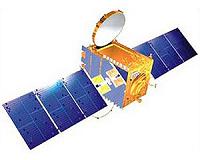
Bangalore, India (SPX) May 27, 2011 India's advanced communication satellite, GSAT-8, launched on May 21, 2011 has reached Geosynchronous orbit with an orbital period of 23 hours 45 minutes. The satellite's orbit has a perigee of 35,543 km, apogee of 35,770 km and an orbital inclination of 0.04 deg with respect to the equatorial plane. The solar arrays on both sides of the satellite have been deployed and they are tracking the Sun and generating electrical power. These solar arrays are designed to generate 6,240 W of electrical power. Two large dual grid Ku-band antennae have been opened and are pointing towards the Earth. The satellite has been put into the final orbital configuration pointing towards the Earth continuously. GSAT-8 is presently located at 47 deg East longitude and is being moved towards its final orbital position of 55 deg East where it will be co-located with INSAT-3E satellite. In Orbit Testing (IOT) of 24 Ku-band transponders of GSAT-8 is scheduled to begin on June 1, 2011 and the satellite is expected to be ready for service in about a month. Testing of the GAGAN navigational payload will be conducted from the new Navigation Control Centre at Kundanahalli near Bangalore.
Share This Article With Planet Earth
Related Links ISRO Space Technology News - Applications and Research

 Success of GSAT-8 and Future of India's Space Programme
New Delhi, India (SPX) May 26, 2011 India's advanced communication geostationary satellite, GSAT-8, was successfully launched on May 21, 2011. The satellite was put in orbit from French Guiana by the Ariane-V launch vehicle. Indian Space Research Organisation's (ISRO) master control facility has already started acquiring signals from this satellite. It would take a few more days for this satellite to become fully operational. ... read more |
|
|
| The content herein, unless otherwise known to be public domain, are Copyright 1995-2010 - SpaceDaily. AFP and UPI Wire Stories are copyright Agence France-Presse and United Press International. ESA Portal Reports are copyright European Space Agency. All NASA sourced material is public domain. Additional copyrights may apply in whole or part to other bona fide parties. Advertising does not imply endorsement,agreement or approval of any opinions, statements or information provided by SpaceDaily on any Web page published or hosted by SpaceDaily. Privacy Statement |


 del.icio.us
 Digg
Digg Reddit
 YahooMyWeb
 Google
 Facebook


