
 |
 |
 |
 |
 |
 |
 |
 |
 |

 |

Bonn, Germany (SPX) Nov 17, 2010 Germany's first experiment in space robotics has now come to an end. On the evening of 15 November 2010, Russian cosmonauts Fyodor Yurichikhin and Oleg Skripochka performed a space walk during which they removed the Rokviss robotic arm developed by the German Aerospace Center from the experimental platform on the Russian service module Svezda and took it inside the ISS. By 2 November 2010, the Rokviss team from the DLR Robotics and Mechatronics Center in Oberpfaffenhofen had moved the robot arm into the required position for this operation. Only in this position could Rokviss be easily transported through the air lock and into the interior of the ISS. For the last five and a half years - from 22 March 2005 until 2 November 2010 - this robot arm, measuring 50 centimetres in length and weighing seven kilograms, has been operating in space and has completed somewhere in the region of 500 successful tests. With its two articulated joints and a metal finger, Rokviss has been able to perform high-precision work in space.
Four to six contacts a month Four to six times a month, the researchers established contact with the robot arm, whenever the ISS passed over the reception area of the antenna system at the DLR facility in Weilheim, near Oberpfaffenhofen, thereby making the transfer of data possible. The aim of the experiment was to test and verify new hardware and powerful robot control concepts during real mission operations. In future, this technology will support astronauts and lighten their workload during complex tasks, and it will also help to repair satellites in orbit. Conditions in space are radically different from those on Earth; there is no air and temperatures inside the robot joints range from minus 20 to plus 60 degrees Celsius. However, removal of Rokviss from the ISS does not complete the work of the DLR researchers. By March 2011, the two joint units are to be unfastened from their baseplate and the camera unit is also scheduled for disassembly. This is the only way to get the joints to fit in the small storage space available on the Soyuz capsule in which they are to be returned to Earth. By the end of April 2011, project manager Klaus Landzettel and his colleagues expect Rokviss to be back in the DLR Robotics and Mechatronics Center in Oberpfaffenhofen. Then, by carefully examining the extent of the mechanical wear, further essential information can be obtained and then applied to the building of future space robots.
Share This Article With Planet Earth
Related Links DLR - German Aerospace Center Station at NASA Station and More at Roscosmos S.P. Korolev RSC Energia Watch NASA TV via Space.TV Space Station News at Space-Travel.Com

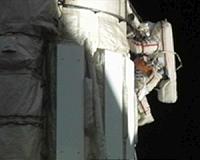 ISS Crew Completes Spacewalk
Houston TX (SPX) Nov 16, 2010 Expedition 25 Flight Engineers Fyodor Yurchikhin and Oleg Skripochka ended Monday's spacewalk at 4:22 p.m. EST. The excursion lasted six hours and 27 minutes. The primary assembly and maintenance objectives of the spacewalk were to install a multipurpose workstation on the starboard side of the Zvezda service module's large-diameter section and relocate a television camera from one end of ... read more |
|
|
| The content herein, unless otherwise known to be public domain, are Copyright 1995-2010 - SpaceDaily. AFP and UPI Wire Stories are copyright Agence France-Presse and United Press International. ESA Portal Reports are copyright European Space Agency. All NASA sourced material is public domain. Additional copyrights may apply in whole or part to other bona fide parties. Advertising does not imply endorsement,agreement or approval of any opinions, statements or information provided by SpaceDaily on any Web page published or hosted by SpaceDaily. Privacy Statement |


 del.icio.us
 Digg
Digg Reddit
 YahooMyWeb
 Google
 Facebook


