
 |
 |
 |
 |
 |
 |
 |
 |
 |

 |

Tucson AZ (SPX) Sep 16, 2010 Glaciers can help actively growing mountains become higher by protecting them from erosion, according to a University of Arizona-led research team. The finding is contrary to the conventional view of glaciers as powerful agents of erosion that carve deep fjords and move massive amounts of sediment down mountains. Mountains grow when movements of the Earth's crust push the rocks up. The research is the first to show that the erosion effect of glaciers - what has been dubbed the "glacial buzzsaw" - reverses on mountains in colder climates. The researchers were surprised, said first author Stuart N. Thomson, a research scientist in the UA department of geosciences. "We were expecting to see the buzzsaw." The team discovered the protective effects of glaciers by studying the Andes Mountains in the southernmost region of South America, known as Patagonia. UA co-author Peter W. Reiners said, "It's been thought that glaciers limit the height of mountain ranges worldwide." The key is climate. Glaciers atop mountains in temperate latitudes flow downhill, scouring away the surface of the mountain. Over millennia, such erosion can reduce the height and width of a mountain range by miles. However in very cold climates such as the Patagonian Andes, rather than scraping away the surface of the mountain, the team found that glaciers protect the mountain top and sides from erosion. The team dubs the action of the cold-climate glaciers "glacial armoring." "Climate, especially through glaciers, has a really big impact on how big mountains get," said Reiners, a UA professor of geosciences. "What we're seeing is that below certain latitudes, glacial buzzsaws clearly and efficiently operate, but south of about 45 degrees, it not only doesn't work - it has the opposite effect," he said. "The glaciers actually protect the surface and allow the mountains to grow higher." He and his colleagues anticipate that glacial armoring also occurs on cold-climate mountains very far north, such as those in Alaska. The team's paper, "Glaciation as a destructive and constructive control on mountain building," is scheduled for publication in the Sept. 16 issue of the journal Nature. Additional co-authors are Mark T. Brandon and Nathaniel J. Wilson of Yale University in New Haven, Conn.; Jonathan H. Tomkin of the University of Illinois at Urbana-Champaign; and Cristian Vasquez of the Universidad de Chile in Santiago. The National Science Foundation and the Chilean Fondecyt funded the work. The Andes are the textbook example of actively growing mountains that are limited in height and size by glaciers, Thomson said. The Andes are actively being pushed higher by movements of the Earth's crust. However, if the glacial buzzsaw is active, the mountains also are ground down. "We're trying to understand how mountains are built and destroyed," Thomson said. "Why are mountains high?" In actively growing mountains, hot rocks from deep in the Earth are being thrust up. At the same time, erosion sands away the tops and sides of the mountains, bringing those once-hot rocks closer to surface. The speed at which the rocks cool indicates how rapidly the surface material above the rocks was removed by erosion. To figure out how fast the glaciers had scoured the Andes, Thomson and his colleagues needed to analyze rocks now exposed on the mountains. The scientists sailed up glacially-cut fjords to the foot of remote glaciers and collected soccer-ball-sized rocks. The team collected rocks from latitude 38 degrees south to 56 degrees south, for a total of 146 samples. The researchers analyzed the rocks in laboratories at the UA and at Yale University to determine what geologists call the "cooling age" of the rocks. The cooling age tells how fast the rock was exposed by erosion. The researchers used two independent dating methods, apatite uranium-thorium-helium and fission-track dating, to determine cooling ages. Both methods showed the same result - that the rocks cooled faster in the north and slower in the south. The slower the cooling, the more slowly the mountains are eroding. Reiners said, "What corroborates this is that the mountains are higher in the south than in the north. Uplift is winning in the south, and the glacial buzzsaw is winning in the north." The importance of climate in the formation of mountains is currently a matter of scientific debate, Thomson said. The new finding indicates that climate plays a key role. Said Thomson: "Climate determines the size of a mountain range - whether there is a glacial buzzsaw or glacial armoring."
Share This Article With Planet Earth
Related Links University of Arizona Beyond the Ice Age

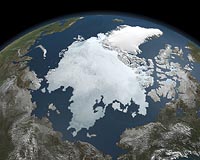 Arctic sea ice shrinks to third lowest area on record
Washington (AFP) Sept 15, 2010 Arctic sea ice melted over the summer to cover the third smallest area on record, US researchers said Wednesday, warning global warming could leave the region ice free in the month of September 2030. Last week, at the end of the spring and summer "melt season" in the Arctic, sea ice covered 4.76 million square kilometers (1.84 million square miles), the University of Colorado's National Snow ... read more |
|
|
| The content herein, unless otherwise known to be public domain, are Copyright 1995-2010 - SpaceDaily. AFP and UPI Wire Stories are copyright Agence France-Presse and United Press International. ESA Portal Reports are copyright European Space Agency. All NASA sourced material is public domain. Additional copyrights may apply in whole or part to other bona fide parties. Advertising does not imply endorsement,agreement or approval of any opinions, statements or information provided by SpaceDaily on any Web page published or hosted by SpaceDaily. Privacy Statement |


 del.icio.us
 Digg
Digg Reddit
 YahooMyWeb
 Google
 Facebook


