
 |
 |
 |
 |
 |
 |
 |
 |
 |

 |

Greenbelt MD (SPX) Nov 10, 2010 Of all the pollution that fills our lungs on any given day, the most dangerous is the small stuff. Aerosol particle pollution-airborne solid particles and liquid droplets-comes in a range of sizes. Particles smaller than 2.5 micrometers pose the greatest risk to human health because they are small enough to be breathed deep into the lungs and, in some cases, enter the blood stream. These fine particles, about 30 times smaller than the width of a human hair, are also a major cause of poor visibility. This map provides an estimate of the average distribution of fine particles near ground-level throughout the world. The highest concentrations of fine particles, called PM (particulate matter) 2.5, hover over highly industrialized areas in eastern Asia. The high concentrations over northern Africa and the Middle East are likely fine dust from the deserts. The World Health Organization's Air Quality Guidelines recommend that concentrations of particulate pollution should not exceed 10 micrograms per cubic meter. When compared with global population, the map reveals that 80 percent of the world's people live in areas that exceed that value. The map was compiled from satellite measurements (acquired between 2001 and 2006) and from model data. Both the Multi-angle Imaging SpectroRadiometer (MISR) and the Moderate Resolution Imaging Spectroradiometer (MODIS) on NASA's Terra satellite measure particle pollution (aerosols). The GEOS-Chem model was used to help researchers determine how much of the satellite-measured pollution was at ground level, where it poses a threat to human health. More information on aerosols at NASA's Earth Observatory
Share This Article With Planet Earth
Related Links Earth Observatory at NASA The Air We Breathe at TerraDaily.com

 NASA Work Helps Better Predict World's Smoggiest Days
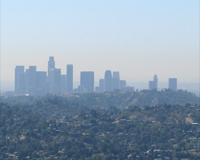
Pasadena CA (JPL) Oct 29, 2010 A research team led by NASA's Jet Propulsion Laboratory and the California Institute of Technology (Caltech), both in Pasadena, Calif., has fully characterized a key chemical reaction that affects the formation of pollutants in smoggy air in the world's urban areas. When applied to Los Angeles, the laboratory results suggest that, on the most polluted days and in the most polluted parts of ... read more |
|
|
| The content herein, unless otherwise known to be public domain, are Copyright 1995-2010 - SpaceDaily. AFP and UPI Wire Stories are copyright Agence France-Presse and United Press International. ESA Portal Reports are copyright European Space Agency. All NASA sourced material is public domain. Additional copyrights may apply in whole or part to other bona fide parties. Advertising does not imply endorsement,agreement or approval of any opinions, statements or information provided by SpaceDaily on any Web page published or hosted by SpaceDaily. Privacy Statement |


 del.icio.us
 Digg
Digg Reddit
 YahooMyWeb
 Google
 Facebook


