
 |
 |
 |
 |
 |
 |
 |
 |
 |

 |

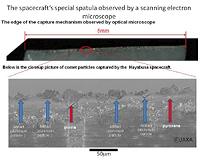
Moffett Field CA (SPX) Nov 22, 2010 The Japan Aerospace Exploration Agency (JAXA) has confirmed that the tiny particles inside the Hayabusa spacecraft's sample return container are in fact from the asteroid Itokawa. Scientists examined the particles to determine if the probe successfully captured and brought back anything from the asteroid, and in a press release said "about 1,500 grains were identified as rocky particles, and most were determined to be of extraterrestrial origin, and definitely from Asteroid Itokawa." These are the first samples from an asteroid ever returned to Earth by a space mission. Studying the samples will help astrobiologists understand the compositon of asteroids and their potential role in delivering materials to the Earth that were essential for the origin of life. Previously, JAXA said that although particles were inside the container, it wasn't clear if they were from the asteroid or if they could be of terrestrial origin (dust from Earth that could have been inside the container). The particles samples were collected from the chamber by a specially shaped Teflon spatula and examined with a scanning electron microscope. There were two chambers inside the container, and from the press release (in Japanese) it appears all the particles were found in one chamber, Chamber A. Most of the particles are extremely small, about 10 microns in size and require special handling and equipment. Unfortunately they aren't the "peanut-sized" chunks of rock that the mission originally hoped to capture. This will make analyzing the particles difficult, but not impossible. During the seven-year round trip journey, Hayabusa arrived at Itokawa in November, 2005. The mechanism that was intended to capture the samples apparently failed, but scientists were hopeful that at least some dust had made its way into the return canister. After a circuitous and troubled-filled return trip home, the sample return capsule was ejected and landed in Australia in June of this year. Here are the other successful sample return missions: + Apollo Moon missions (1969-1972) + Soviet Union's Luna 16 (1970) returned 101 grams of lunar soil. + Luna 20 (1974) returned 30 grams. + Luna 24 (1976) returned 170.1 grams. + The Orbital Debris Collection (ODC) experiment, deployed on the Mir space station for 18 months during 1996-1997, used aerogel to capture interplanetary dust particles in orbit. + Genesis (2001-2004) captured and returned molecules collected from the solar wind. It crashed in the Utah desert, but samples were able to be retreived. + Stardust (1999-2006) collected particles from the tail of a comet, as well as a few interstellar dust grains.
Share This Article With Planet Earth
Related Links Japan Aerospace Exploration Agency (JAXA) Asteroid and Comet Mission News, Science and Technology

 Hayabusa Spacecraft Returns Asteroid Artifacts From Space
Washington DC (SPX) Nov 18, 2010 Scientists involved with the first space mission attempting to sample asteroid surface material and return to Earth, have confirmed presence of particles collected from a small container aboard the Japan Aerospace Exploration Agency (JAXA) Hayabusa spacecraft. On June 13, 2010, Hayabusa visited the near-Earth asteroid, called Itokawa. The spacecraft landed at Australia's remote Woomera Tes ... read more |
|
|
| The content herein, unless otherwise known to be public domain, are Copyright 1995-2010 - SpaceDaily. AFP and UPI Wire Stories are copyright Agence France-Presse and United Press International. ESA Portal Reports are copyright European Space Agency. All NASA sourced material is public domain. Additional copyrights may apply in whole or part to other bona fide parties. Advertising does not imply endorsement,agreement or approval of any opinions, statements or information provided by SpaceDaily on any Web page published or hosted by SpaceDaily. Privacy Statement |


 del.icio.us
 Digg
Digg Reddit
 YahooMyWeb
 Google
 Facebook


