
 |
 |
 |
 |
 |
 |
 |
 |
 |

 |

Santa Barbara CA (SPX) Feb 18, 2011 An important milestone toward the realization of a large-scale quantum computer, and further demonstration of a new level of the quantum control of light, were accomplished by a team of scientists at UC Santa Barbara and in China and Japan. The study, published in the Feb. 7 issue of the journal Physical Review Letters, involved scientists from Zhejiang University, China, and NEC Corporation, Japan. The experimental effort was pursued in the research groups of UCSB physics professors Andrew Cleland and John Martinis. The team described how they used a superconducting quantum integrated circuit to generate unique quantum states of light known as "NOON" states. These states, generated from microwave frequency photons, the quantum unit of light, were created and stored in two physically-separated microwave storage cavities, explained first author Haohua Wang, postdoctoral fellow in physics at UCSB. The quantum NOON states were created using one, two, or three photons, with all the photons in one cavity, leaving the other cavity empty. This was simultaneous with the first cavity being empty, with all the photons stored in the second cavity. "This seemingly impossible situation, allowed by quantum mechanics, led to interesting results when we looked inside the cavities," said second author Matteo Mariantoni, postdoctoral fellow in physics at UCSB. "There was a 50 percent chance of seeing all the photons in one cavity, and a 50 percent chance of not finding any - in which case all the photons could always be found in the other cavity." However, if one of the cavities was gently probed before looking inside, thus changing the quantum state, the effect of the probing could be seen, even if that cavity was subsequently found to be empty, he added. "It's kind of like the states are ghostly twins or triplets," said Wang. "They are always together, but somehow you never know where they are. They also have a mysterious way of communicating, so they always seem to know what is going to happen." Indeed, these types of states display what Einstein famously termed, "spooky action at a distance," where prodding or measuring a quantum state in one location affects its behavior elsewhere. The quantum integrated circuit, which includes superconducting quantum bits in addition to the microwave storage cavities, forms part of what eventually may become a quantum computational architecture.
Share This Article With Planet Earth
Related Links University of California - Santa Barbara Stellar Chemistry, The Universe And All Within It

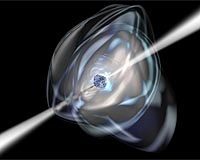 Faster-Than-Light Polarization Currents
Los Alamos NM (SPX) Jan 06, 2010 Pulsars are neutron stars that emit amazingly regular, short bursts of radio waves, so regular that they were originally thought to be signals from little green men! Though their discovery over 40 years ago was very widely reported and resulted in a Nobel Prize, the reasons how and why they send these bursts has remained a mystery; to quote Jean Eilek of NRAO, "we know why they pulse, but why do ... read more |
|
|
| The content herein, unless otherwise known to be public domain, are Copyright 1995-2010 - SpaceDaily. AFP and UPI Wire Stories are copyright Agence France-Presse and United Press International. ESA Portal Reports are copyright European Space Agency. All NASA sourced material is public domain. Additional copyrights may apply in whole or part to other bona fide parties. Advertising does not imply endorsement,agreement or approval of any opinions, statements or information provided by SpaceDaily on any Web page published or hosted by SpaceDaily. Privacy Statement |


 del.icio.us
 Digg
Digg Reddit
 YahooMyWeb
 Google
 Facebook


