
 |
 |
 |
 |
 |
 |
 |
 |
 |

 |

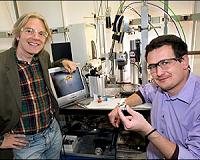
Providence RI (SPX) Dec 20, 2010 A pipefitter knows how to make an exact cut on a metal rod. But it's far harder to imagine getting a precise cut on a carbon nanotube, with a diameter 1/50,000th the thickness of a human hair. In a paper published this month in the British journal Proceedings of the Royal Society A, researchers at Brown University and in Korea document for the first time how single-walled carbon nanotubes are cut, a finding that could lead to producing more precise, higher-quality nanotubes. Such manufacturing improvements likely would make the nanotubes more attractive for use in automotive, biomedicine, electronics, energy, optics and many other fields. "We can now design the cutting rate and the diameters we want to cut," said Kyung-Suk Kim, professor of engineering in the School of Engineering at Brown and the corresponding author on the paper. The basics of carbon nanotube manufacturing are known. Single-atom thin graphene sheets are immersed in solution (usually water), causing them to look like a plate of tangled spaghetti. The jumbled bundle of nanotubes is then blasted by high-intensity sound waves that create cavities (or partial vacuums) in the solution. The bubbles that arise from these cavities expand and collapse so violently that the heat in each bubble's core can reach more than 5,000 degrees Kelvin, close to the temperature on the surface of the sun. Meanwhile, each bubble compresses at an acceleration 100 billion times greater than gravity. Considering the terrific energy involved, it's hardly surprising that the tubes come out at random lengths. Technicians use sieves to get tubes of the desired length. The technique is inexact partly because no one was sure what caused the tubes to fracture. Materials scientists initially thought the super-hot temperatures caused the nanotubes to tear. A group of German researchers proposed that it was the sonic boomlets caused by collapsing bubbles that pulled the tubes apart, like a rope tugged so violently at each end that it eventually rips. Kim, Brown postdoctoral researcher Huck Beng Chew, and engineers at the Korea Institute of Science and Technology decided to investigate further. They crafted complex molecular dynamics simulations using an array of supercomputers to tease out what caused the carbon nanotubes to break. They found that rather than being pulled apart, as the German researchers had thought, the tubes were being compressed mightily from both ends. This caused a buckling in a roughly five-nanometer section along the tubes called the compression-concentration zone. In that zone, the tube is twisted into alternating 90-degree-angle folds, so that it fairly resembles a helix. That discovery still did not explain fully how the tubes are cut. Through more computerized simulations, the group learned the mighty force exerted by the bubbles' sonic booms caused atoms to be shot off the tube's lattice-like foundation like bullets from a machine gun. "It's almost as if an orange is being squeezed, and the liquid is shooting out sideways," Kim said. "This kind of fracture by compressive atom ejection has never been observed before in any kind of materials." The team confirmed the computerized simulations through laboratory tests involving sonication and electron microscopy of single-walled carbon nanotubes. The group also learned that cutting single-walled carbon nanotubes using sound waves in water creates multiple kinks, or bent areas, along the tubes' length. The kinks are "highly attractive intramolecular junctions for building molecular-scale electronics," the researchers wrote. Huck Beng Chew, a postdoctoral researcher in Brown's School of Engineering, is the first author on the paper. Myoung-Woon Moon and Kwang Ryul Lee, from the Korea Institute of Science and Technology, contributed to the research. The U.S. National Science Foundation and the Korea Institute of Science and Technology funded the work.
Share This Article With Planet Earth
Related Links Brown University Nano Technology News From SpaceMart.com Computer Chip Architecture, Technology and Manufacture

 Structural Distortions Emerge From Nothing At The Nanoscale
Upton NY (SPX) Dec 20, 2010 Scientists have discovered that a class of materials known to convert heat to electricity and vice versa behaves quite unexpectedly at the nanoscale in response to changes in temperature. The discovery is a new "opposite-direction" phase transition that helps explain the strong thermoelectric response of these materials. It may also help scientists identify other useful thermoelectrics, an ... read more |
|
|
| The content herein, unless otherwise known to be public domain, are Copyright 1995-2010 - SpaceDaily. AFP and UPI Wire Stories are copyright Agence France-Presse and United Press International. ESA Portal Reports are copyright European Space Agency. All NASA sourced material is public domain. Additional copyrights may apply in whole or part to other bona fide parties. Advertising does not imply endorsement,agreement or approval of any opinions, statements or information provided by SpaceDaily on any Web page published or hosted by SpaceDaily. Privacy Statement |


 del.icio.us
 Digg
Digg Reddit
 YahooMyWeb
 Google
 Facebook


