
 |
 |
 |
 |
 |
 |
 |
 |
 |

 |

Guelph, Canada (SPX) Jul 27, 2010 Monarch butterflies - renowned for their lengthy annual migration to and from Mexico - complete an even more spectacular journey home than previously thought. New research from the University of Guelph reveals that some North American monarchs born in the Midwest and Great Lakes fly directly east over the Appalachians and settle along the eastern seaboard. Previously, scientists believed that the majority of monarchs migrated north directly from the Gulf coast. The study appears in the recent issue of the scientific journal Biology Letters. "It's a groundbreaking finding," said Ryan Norris, a Guelph professor in the Department of Integrative Biology who worked on the study with his graduate student Nathan Miller and two researchers from Environment Canada. "It solves the long-standing mystery of why monarchs always show up later on the east coast compared to the interior," he said. "Importantly, it means that the viability of east coast populations is highly dependent upon productivity on the other side of the mountains." Monarchs travel thousands of kilometres each year from wintering sites in central Mexico back to North America's eastern coast, a journey that requires multiple generations produced at various breeding regions. Biologists had suspected that monarchs fly back from Mexico west-to-east over the Appalachians but no evidence existed to support the theory. "Ours is the first proof of longitudinal migration," Miller said. For the study, the researchers collected 90 monarch samples from 17 sites between Maine and Virginia in June and July of 2009. They also collected 180 samples of milkweed (the only plant monarch larvae can eat) from 36 sites along the eastern coast between May and July of that year. They then used hydrogen and carbon isotope measurements to determine when and where the monarchs were born. Isotope values in milkweed vary longitudinally and can be measured in monarch wings, Miller said. "It provides a natal, geospatial fingerprint that is fixed for the duration of the butterfly's lifespan." The researchers discovered that 88 per cent of the monarchs sampled originated in the midwest and Great Lakes regions. "This means that the recolonization of the east coast is by second-generation monarchs that hatched around the Great Lakes and then migrated eastward over the Appalachians," Miller said. The monarch butterfly has been listed as a species of "special concern" in Canada since 1997. Past conservation efforts have often focused on breeding sites along a northward migration route. "Our results suggest that this needs to change," Miller said. "We must target the Great Lakes region to conserve the east coast monarch populations."
Share This Article With Planet Earth
Related Links University of Guelph Darwin Today At TerraDaily.com

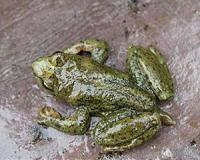 Primitive Frogs Do A Belly Flop
Edwardsville IL (SPX) Jul 26, 2010 Sometimes divers, to their own painful dismay, do belly flops. But did you ever see a frog belly flop? That's just what primitive living frogs do, according to a new study by Dr. Richard Essner, from Southern Illinois University Edwardsville in the US, and colleagues, looking at the evolution of frog jumping and landing. They found that frogs became proficient at jumping before they perfec ... read more |
|
|
| The content herein, unless otherwise known to be public domain, are Copyright 1995-2010 - SpaceDaily. AFP and UPI Wire Stories are copyright Agence France-Presse and United Press International. ESA Portal Reports are copyright European Space Agency. All NASA sourced material is public domain. Additional copyrights may apply in whole or part to other bona fide parties. Advertising does not imply endorsement,agreement or approval of any opinions, statements or information provided by SpaceDaily on any Web page published or hosted by SpaceDaily. Privacy Statement |


 del.icio.us
 Digg
Digg Reddit
 YahooMyWeb
 Google
 Facebook


