
 |
 |
 |
 |
 |
 |
 |
 |
 |

 |

Bochum, Germany (SPX) Dec 20, 2010 Plants that "lose the battle" during competitiveness for light because they are shaded by larger neighbours, counteract. They adapt by rapid shoot elongation and stretch their leaves towards the sun. The molecular basis of this so-called shade avoidance syndrome had been unclarified to date. Research scientists from the Utrecht University in the Netherlands and the Ruhr University in Bochum have now been able to unravel a regulation pathway. A specific transport protein (PIN3) enables the accumulation of the plant hormone auxin, which plays an important role during this adaptation process, in the outer cell layers of the plants, thus enhancing the growth process. The international group of researchers, which includes the plant hormone specialist Prof. Stephan Pollmann from the RUB, has published its observations in the current edition of the Proceedings of the National Academy of Science PNAS.
Suddenly in the shade: plants counteract Prof. Pollmann explained that chlorophyll, the photosynthetic pigment in the leaves, absorbs almost all shades of blue and far red, only allowing dark red light to pass through the leaves. There is a significant change in the red to far-red ratio if a plant is shaded by foliage. If the light receptors in the plants register this change, they initiate a number of adjustment mechanisms in their growth and development program. Taken together these constitute the so-called shadow avoidance syndrome. They enhance the growth of shoots and the upward movement of the leaves (i.e. the hyponastic response).
Auxins play a significant role They play a decisive role in almost all plant growth processes, including the shade avoidance reaction. To date, the underlying mechanism was however not fully comprehended. Prof. Pollmann stated that it had been known that the effect of auxin is based on an interaction of auxin formation, transportation and signal transduction. These processes are all influenced by a low red to far-red ratio, but the exact mechanisms were not understood.
Protein distribution ensures directional the flow of hormones They made an interesting observation, namely that shoot growth during a low red to far-red ratio is subject to an intact auxin perception mechanism and is dependent on the accumulation of auxin in the shoot. The auxin transport protein PIN-FoRMED 3 (PIN3) is primarily responsible for this accumulation. The formation of PIN3 is enhanced when the ratio between red to far red is low. It primarily accumulates in the lateral endodermal cell walls. This distribution of PIN3 leads to an auxin flow towards the epidermal cell layers, which are responsible for the elongation growth of the shoot.
Comparison between plants in light and shade The shade avoidance syndrome was not present in the genetically altered plants without PIN3. Prof. Pollmann summarized that it is thus possible to deduce the important role of PIN3 controlled auxin accumulation during the shade avoidance reaction.
Share This Article With Planet Earth
Related Links Utrecht University Darwin Today At TerraDaily.com

 Efficient Phosphorus Use By Phytoplankton
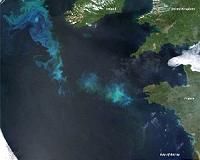
Southampton (UK) (SPX) Dec 20, 2010 Rapid turnover and remodelling of lipid membranes could help phytoplankton cope with nutrient scarcity in the open ocean. A team led by Patrick Martin of the National oceanography Centre has shown that a species of planktonic marine alga can rapidly change the chemical composition of its cell membranes in response to changes in nutrient supply. The findings indicate that the process may be ... read more |
|
|
| The content herein, unless otherwise known to be public domain, are Copyright 1995-2010 - SpaceDaily. AFP and UPI Wire Stories are copyright Agence France-Presse and United Press International. ESA Portal Reports are copyright European Space Agency. All NASA sourced material is public domain. Additional copyrights may apply in whole or part to other bona fide parties. Advertising does not imply endorsement,agreement or approval of any opinions, statements or information provided by SpaceDaily on any Web page published or hosted by SpaceDaily. Privacy Statement |


 del.icio.us
 Digg
Digg Reddit
 YahooMyWeb
 Google
 Facebook


