|
 |
 |
 |
 |
 |
 |
 |
 |

 |
Iraq begins sixth year of chaos, bloodshed
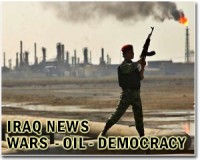
Baghdad (AFP) March 20, 2008 The US-led war on Iraq that toppled the brutal regime of dictator Saddam Hussein entered its sixth year on Thursday with millions of Iraqis still battling daily chaos and rampant bloodshed. On March 20, 2003, US planes dropped the first bombs on Baghdad. Within three weeks, invading troops who toppled Saddam were left battling a resentful and rebellious people. Iraqi Prime Minister Nuri al-Maliki said the invasion ended Saddam's iron-fisted rule and ushered in an era in which "Iraq is liberated in all the fields." "Freedom of speech flourishes in new Iraq. The government no longer controls the intellectuals and chains them down," Maliki said at a function in the central city of Hilla. "Today they enjoy democracy after suffering under the tyrant who treated them as outcast." Five years on, Iraqis, US and allied forces face daily attacks from insurgents and Islamist militants, and fighting continues between factions from both sides of Iraq's Sunni-Shiite sectarian divide. The war has killed tens of thousands of Iraqi civilians. Between 104,000 and 223,000 died between March 2003 and June 2006 alone, according to the World Health Organisation. More than 4,000 US and allied soldiers have also lost their lives. "The war has been an unlimited disaster in terms of US foreign policy, in terms of stability in Iraq and in the Middle East," Joost Hiltermann, Iraq expert with the International Crisis Group, told AFP. "I can only hope the US finds a way to navigate itself out of the mess without allowing Iraq to fall apart." US President George W. Bush defended the war that has already cost his country more than 400 billion dollars but admitted the human cost was high. "The answers are clear to me: removing Saddam Hussein from power was the right decision -- and this is a fight America can and must win," he said in a speech at the Pentagon. Al-Qaeda chief Osama bin Laden issued a video message on Wednesday voicing his determination to fight the United States in Iraq and Afghanistan. He said the "savage acts" of the US-led forces in those countries "haven't ended the war, but rather increased our determination to cling to our right, avenge our people and expel the invaders from our country." In another message on Thursday, he urged Muslims to back the insurgency in Iraq as the best way to support the Palestinians. "The nearest Jihad (holy war) battlefield to support our people in Palestine is the battlefield of Iraq ... It should be taken care of and supported," an audiotape said. On the streets of Baghdad, fear of Saddam's hated secret police has been replaced by a new terror. Tobacconist Abu Fares al-Daraji said Americans "brought our way things we never knew like terrorism and the killings we see on the streets." And in the United States, the war is deeply unpopular, with activists staging demonstrations demanding an immediate withdrawal of US soldiers. "This war needs to end and it needs to end now," said Leslie Cagan, national coordinator of United for Peace and Justice. And a survey carried out by CBS television said the war still remains deeply unpopular, with some 54 percent of Americans polled against it. The top UN official in Iraq, Staffan de Mistura, told AFP in an interview that time is running out for Iraqi leaders to resolve differences hampering the political progress. "It is a key day in Iraq today. But this is a key year for Iraq more than just a day. We feel this is the year in which many courageous decisions have to be taken to show that Iraqis can go forward," said the UN secretary general's representative. Hans Blix, the former chief UN weapons inspector, in an article for Britain's Guardian newspaper, slammed the Iraq war as a "tragedy -- for Iraq, for the US, for the UN, for truth and human dignity." However, Bush has taken heart from signs that the bloodshed has fallen, but even the US commander, General David Petraeus, admits that Baghdad has made insufficient progress towards national reconciliation. The International Committee of the Red Cross said the plight of millions of Iraqis who still have little or no access to clean water, sanitation or health care was the "most critical in the world." Nevertheless, a "surge" in US forces, which over the past year increased the troop level to more than 160,000, has helped reduce the violence in central and western regions. At the same time, radical Shiite cleric Moqtada al-Sadr has ordered his powerful Mahdi Army militia to refrain from attacking Iraqi and US forces. Liwa Sumaysim, one of his top aides, renewed a call for the withdrawal of American forces. "US forces must depart as they are invaders and brought us nothing but terror, destruction and bloodshed," he said. Insurgents continue to carry out spectacular attacks, such as a bombing on Monday in the Shiite shrine city of Karbala that killed 52 people. At a national unity conference on Tuesday -- undermined by a boycott from two key parliamentary blocs -- Maliki boasted that Iraq's sectarian civil war was over. And for the first time since becoming premier, on Wednesday he visited Baghdad's Sunni bastion of Adhamiyah where he promised Sunni Arabs jobs as a reward for their fight against Al-Qaeda. The economy, the main concern of Iraqis after security, is also a wreck. Unemployment is running at between 25 and 50 percent, according to government figures. Oil exports, the country's main money-earner, are a key source of contention between rival political factions. Iraqi officials say production is at 2.9 million barrels per day, higher than pre-war levels when Saddam's Iraq was under UN sanctions. Oil analysts believe it is really around 2.2 million. Such public services as water and electricity have yet to be fully restored, despite billions of dollars having been spent on often badly managed reconstruction projects. Community Email This Article Comment On This Article Related Links Iraq: The first technology war of the 21st century
 Analysis: Marriage of convenience in Iraq
The U.S. military's use of organic forces in Iraq gives a sense of Iraqi solutions to Iraqi problems, but may also be a sign of a partnership of convenience. |
|
|

| The content herein, unless otherwise known to be public domain, are Copyright 1995-2007 - SpaceDaily.AFP and UPI Wire Stories are copyright Agence France-Presse and United Press International. ESA Portal Reports are copyright European Space Agency. All NASA sourced material is public domain. Additional copyrights may apply in whole or part to other bona fide parties. Advertising does not imply endorsement,agreement or approval of any opinions, statements or information provided by SpaceDaily on any Web page published or hosted by SpaceDaily. Privacy Statement |