
 |
 |
 |
 |
 |
 |
 |
 |
 |

 |

Greenbelt MD (SPX) Mar 10, 2011 The Integrated Science Instrument Module, or ISIM, is the structural heart of the James Webb Space Telescope, what engineers call the main payload. It will house the four main scientific instruments of the telescope. The ISIM is like a chassis in a car providing support for the engine and other components. Webb will undergo significant shaking when it is launched on the large Ariane V rocket. To be sure the telescope's "chassis" is ready for this "bumpy road," the ISIM is subjected to some extreme testing. During the testing process, the ISIM is spun and shaken while many measurements are taken. Afterwards, engineers compare the measurements with their models of the ISIM. If there are discrepancies, then the engineers track down why, and make corrections. Webb will be the first next-generation large space observatory and will serve thousands of astronomers worldwide. Designed to detect light from as far away as approximately 14 billion light years, Webb will study every phase in the history of our Universe, ranging from the first luminous glows after the Big Bang, to the formation of planetary systems capable of supporting life on planets like Earth, to the evolution of our own Solar System. The Webb telescope is a joint mission of NASA, the European Space Agency and Canadian Space Agency.
Share This Article With Planet Earth
Related Links James Webb Space Telescope Space Telescope News and Technology at Skynightly.com

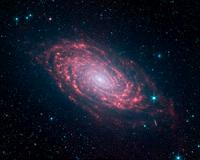 Spitzer Captures Infrared Rays From A Sunflower
Pasadena CA (JPL) Mar 07, 2011 The various spiral arm segments of the Sunflower galaxy, also known as Messier 63, show up vividly in this image taken in infrared light by NASA's Spitzer Space Telescope. Infrared light is sensitive to the dust lanes in spiral galaxies, which appear dark in visible-light images. Spitzer's view reveals complex structures that trace the galaxy's spiral arm pattern. Messier 63 lies 37 millio ... read more |
|
|
| The content herein, unless otherwise known to be public domain, are Copyright 1995-2010 - SpaceDaily. AFP and UPI Wire Stories are copyright Agence France-Presse and United Press International. ESA Portal Reports are copyright European Space Agency. All NASA sourced material is public domain. Additional copyrights may apply in whole or part to other bona fide parties. Advertising does not imply endorsement,agreement or approval of any opinions, statements or information provided by SpaceDaily on any Web page published or hosted by SpaceDaily. Privacy Statement |


 del.icio.us
 Digg
Digg Reddit
 YahooMyWeb
 Google
 Facebook


