
 |
 |
 |
 |
 |
 |
 |
 |
 |

 |

Melbourne, Australia (SPX) Oct 07, 2010 Work based on data from the Australian Astronomical Observatory has discounted one route for forming stars. The work is this week's cover story in the journal Nature. In their paper ("High star formation rates as the origin of turbulence in early and modern disk galaxies"), Swinburne University astronomy student Andy Green, Green's supervisor and team leader Professor Karl Glazebrook, and their colleagues report finding galaxies in today's Universe that were thought to exist only in the distant past. "They're living fossils of space - galaxies we just didn't expect to find in today's world," said Green. The galaxies in question are like our own Galaxy in shape, but unlike our Galaxy they are physically turbulent and are forming lots of stars. Astronomers see many of them in the distant, early Universe, but they are rare now, and this team is the first to find any in today's Universe. The finding knocks on the head one way astronomers thought stars might form. Stars form from gas, and to form rapidly they need a good supply of it. Astronomers had thought that star formation in distant, early galaxies might be fuelled by cold streams of gas continually falling into those galaxies. But this mechanism could only work when the Universe was young. Finding these modern galaxies frenziedly forming new stars calls this idea into question. Instead it seems more likely that galaxies get their new gas through 'mergers and acquisitions' - merging with like-sized counterparts or swallowing smaller galaxies. To find the very rare, turbulent galaxies, Green's team had to observe many galaxies, over a large volume of sky. They started by selecting galaxies from the Sloan Digital Sky Survey that showed a key indicator of star formation: a bright H-alpha spectral line emitted by hydrogen gas. Green then observed these chosen galaxies with the 3.9-meter Anglo-Australian Telescope (AAT), operated by the Australian Astronomical Observatory, and the 2.3-meter telescope of the Australian National University, both located at Siding Spring Observatory in eastern Australia. About two-thirds of the data came from the AAT. Australian Astronomical Observatory Director, Professor Matthew Colless, was a member of the research team. He says the study shows the value of the Australian telescopes for complementing observations of the very distant Universe. "Our telescopes are ideal for detailed study of the nearby counterparts of galaxies seen in the distant universe by the eight- and ten-meter telescopes," he said. "That's essential for piecing together the history of the Universe, from ancient times down to the present."
Share This Article With Planet Earth
Related Links Australian Astronomical Observatory Stellar Chemistry, The Universe And All Within It

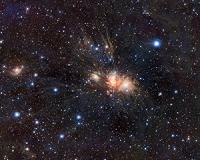 VISTA Reveals Secret Of Unicorn
Paris, France (ESA) Oct 07, 2010 A new infrared image from ESO's VISTA survey telescope reveals an extraordinary landscape of glowing tendrils of gas, dark clouds and young stars within the constellation of Monoceros (the Unicorn). This star-forming region, known as Monoceros R2, is embedded within a huge dark cloud. The region is almost completely obscured by interstellar dust when viewed in visible light, but is spectac ... read more |
|
|
| The content herein, unless otherwise known to be public domain, are Copyright 1995-2010 - SpaceDaily. AFP and UPI Wire Stories are copyright Agence France-Presse and United Press International. ESA Portal Reports are copyright European Space Agency. All NASA sourced material is public domain. Additional copyrights may apply in whole or part to other bona fide parties. Advertising does not imply endorsement,agreement or approval of any opinions, statements or information provided by SpaceDaily on any Web page published or hosted by SpaceDaily. Privacy Statement |


 del.icio.us
 Digg
Digg Reddit
 YahooMyWeb
 Google
 Facebook


