
 |
 |
 |
 |
 |
 |
 |
 |
 |

 |

Pasadena CA (JPL) Jul 02, 2010 In a new analysis of a lunar sample collected by Apollo 17, researchers have detected and dated carbon on the moon in the form of graphite - the sooty stuff of pencil lead - which survived from around 3.8 billion years ago, when the moon was heavily bombarded by meteorites. Up to now, scientists thought the trace amounts of carbon previously detected on the surface of the moon came from the solar wind. Some of the graphite revealed by the new study appeared in a rare rolled form known as "graphite whiskers," which scientists believe formed in the very high-temperature reactions initiated by a meteorite impact. The discovery also means that the moon potentially holds a record of the carbon input by meteors into the Earth-moon system when life was just beginning to emerge on Earth. The research is published in the July 2 issue of the journal Science. "The solar system was chaotic, with countless colliding objects 3.9 billion years ago," explained lead author Andrew Steele, based at the Carnegie Institution for Science in Washington, D.C. "Volatiles - compounds like water and elements like carbon - were vaporized under that heat and shock. These materials were critical to the creation of life on Earth." "Materials that fell on the early Earth fell on the moon as well, because the two bodies basically share the same gravity well," said Marc Fries, a planetary scientist who conducted the research while working at NASA's Jet Propulsion Laboratory, Pasadena, Calif., and is now based at the Planetary Science Institute in Tucson, Ariz. "This sample is like a pristine page from Earth's past, before plate tectonics and other forces erased the history of this ancient carbon material on Earth." While the sample from the Mare Serenitatis area came back to Earth in 1972, the research team, led by scientists at the Geophysical Laboratory of the Carnegie Institution for Science, used a new technique known as Raman spectroscopy on the sample. Previous techniques enabled scientists to get a sense of the composition, but this kind of spectroscopy is more sensitive and also allows scientists to create an image of the minerals. The graphite whiskers appeared to be a few micrometers in diameter and up to about 10 microns long. Scientists were surprised at the finding of graphite and graphite whiskers. "It shows that modern spatially resolved techniques could be used to discover further surprises in the now 40-year-old Apollo collection," said co-author Mihaela Glamoclija, based at the Carnegie Institution. The scientists ruled out the possibility that the graphite was a result of contamination, because graphite whiskers, in particular, form under very hot conditions, between 1,830 and 6,500 degrees Fahrenheit (1,273 to 3,900 Kelvin). They also ruled out the solar wind as the source, because the graphite and graphite whiskers were much larger than carbon implanted by the solar wind, and while contamination occurred throughout the sample, the graphite was restricted to a discrete blackened area of the sample. "We believe that the carbon we detected either came from the object that made the impact basin, or it condensed from the carbon-rich gas that was released during impact," said co-author Francis McCubbin, of the Carnegie Institution. The research was partly funded by the NASA Astrobiology, Mars Fundamental Research, and the Lunar Advanced Science and Exploration Research programs in NASA's Planetary Division in Washington. The California Institute of Technology manages JPL for NASA.
Share This Article With Planet Earth
Related Links Carnegie Institution Mars News and Information at MarsDaily.com Lunar Dreams and more

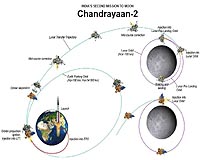 India Hopes To Launch Chandrayaan-2 By 2013
Kolkata, India (PTI) Jul 01, 2010 The Chairman of Indian Space Research Organisation (ISRO) K Radhakrishnan has said India is preparing to launch its second moon mission 'Chandrayaan-2' by 2013. "The Chandrayaan-2 we are planning to have in the year 2013 and by that time we should have our GSLV (Geosynchronous Satellite Launch Vehicle) flying with the Indigenous Cryogenic Engine Stage that's the target with which we are wo ... read more |
|
|
| The content herein, unless otherwise known to be public domain, are Copyright 1995-2010 - SpaceDaily. AFP and UPI Wire Stories are copyright Agence France-Presse and United Press International. ESA Portal Reports are copyright European Space Agency. All NASA sourced material is public domain. Additional copyrights may apply in whole or part to other bona fide parties. Advertising does not imply endorsement,agreement or approval of any opinions, statements or information provided by SpaceDaily on any Web page published or hosted by SpaceDaily. Privacy Statement |


 del.icio.us
 Digg
Digg Reddit
 YahooMyWeb
 Google
 Facebook


