
 |
 |
 |
 |
 |
 |
 |
 |
 |

 |

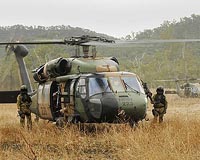
Melbourne FL (SPX) Jul 02, 2010 Northrop Grumman Corporation and the U.S. Navy have begun the next phase of the flight test program leading to the "final exam" Operational Evaluation and potential approval next year for full-rate production of the Airborne Laser Mine Detection System (ALMDS). The Navy is conducting the Developmental Flight Test-IIE (DT-IIE) program from its Surface Warfare Center Panama City Division site in Florida. The first flight occurred on June 8. ALMDS is an airborne mine countermeasures system, one of several systems in development by Northrop Grumman to address the threat posed by mines to U.S. and allied ships. ALMDS uses its pulsed laser light and streak tube receivers to image in 3-D, day or night, the near-surface of the ocean. The system is housed in a pod that is mounted on the port side of an MH-60S helicopter and measures just under nine feet long with a 21-inch diameter. ALMDS will be a key component of the Littoral Combat Ship (LCS) Mine Countermeasures Mission Package. Northrop Grumman also is the LCS Mission Package Integrator for the Navy. "Mines are worldwide, inexpensive, and readily available to terrorists and rogue nations for use against military and commercial ships," said Dan Chang, vice president of Northrop Grumman Maritime and Tactical Systems. "Being able to find them rapidly, without slowing the pace of our fleet, is the purpose of ALMDS. It's about getting the sailor out of the minefield wherever possible." The Navy will fly ALMDS approximately 40 times during the DT-IIE evaluation. A technical evaluation will follow and will lead to the full-scale Operational Evaluation late next year. "We've had four flights to date and, though I can't go into details, the feedback we've gotten is that the system is performing well and reliably," said Chang. "The flight test data have allowed us to make a few minor software adjustments that have sharpened the capabilities of the system." Northrop Grumman has delivered five ALMDS pods to the Navy, all on or ahead of schedule, under LRIP phase-1 and -2 contracts. An LRIP phase-3 contract is expected later this year. In addition to ALMDS, Northrop Grumman is developing the Rapid Airborne Mine Clearance System (RAMICS) for the U.S. Navy, which will use ALMDS data to relocate and then destroy the mines from a safe distance. The company is testing its Airborne Surveillance, Target Acquisition and Minefield Detection System (ASTAMIDS) for the U.S. Army, and its Coastal Battlefield Reconnaissance and Analysis (COBRA) for the Marine Corps.
Share This Article With Planet Earth
Related Links Northrop Grumman The latest in Military Technology for the 21st century at SpaceWar.com

 Fully Accredited Infrared Countermeasures System Effectiveness Models Unveiled
Rolling Meadows IL (SPX) Jul 02, 2010 Northrop Grumman Corporation has announced the development of a unique capability to assess the performance and effectiveness of its offering for the U.S. Army's Common Infrared Countermeasures (CIRCM) program, based on an Infrared Countermeasures (IRCM) system effectiveness tool created by the company and validated by the U.S. government. The Northrop Grumman IRCM system effectiveness too ... read more |
|
|
| The content herein, unless otherwise known to be public domain, are Copyright 1995-2010 - SpaceDaily. AFP and UPI Wire Stories are copyright Agence France-Presse and United Press International. ESA Portal Reports are copyright European Space Agency. All NASA sourced material is public domain. Additional copyrights may apply in whole or part to other bona fide parties. Advertising does not imply endorsement,agreement or approval of any opinions, statements or information provided by SpaceDaily on any Web page published or hosted by SpaceDaily. Privacy Statement |


 del.icio.us
 Digg
Digg Reddit
 YahooMyWeb
 Google
 Facebook


