
 |
 |
 |
 |
 |
 |
 |
 |
 |

 |

Pasadena CA (SPX) Oct 01, 2010 Early on thursday, navigators and mission controllers for NASA's EPOXI mission watched their computer screens as 23.6 million kilometers (14.7 million miles) away, their spacecraft successfully performed its 20th trajectory correction maneuver. The maneuver refined the spacecraft's orbit, setting the stage for its flyby of comet Hartley 2 on Nov. 4. Time of closest approach to the comet was expected to be about 10: 02 a.m. EDT (7:02 a.m. PDT). The trajectory correction maneuver began at 2 p.m. EDT (11 a.m. PDT), when the spacecraft fired its engines for 60 seconds, changing the spacecraft's velocity by 1.53 meters per second (3.4 mph). "We are about 23 million miles and 36 days away from our comet," said EPOXI project manager Tim Larson of NASA's Jet Propulsion Laboratory in Pasadena, Calif. "I can't wait to see what Hartley 2 looks like." On Nov. 4, the spacecraft will fly past the comet at a distance of about 700 kilometers (435 miles). It will be only the fifth time in history that a spacecraft has been close enough to image a comet's nucleus, and the first time in history that two comets have been imaged with the same instruments and same spatial resolution. "We are imaging the comet every day, and Hartley 2 is proving to be a worthy target for exploration," said Mike A'Hearn, EPOXI principal investigator from the University of Maryland, College Park. EPOXI is an extended mission that utilizes the already "in flight" Deep Impact spacecraft to explore distinct celestial targets of opportunity. The name EPOXI itself is a combination of the names for the two extended mission components: the extrasolar planet observations, called Extrasolar Planet Observations and Characterization (EPOCh), and the flyby of comet Hartley 2, called the Deep Impact Extended Investigation (DIXI). The spacecraft will continue to be referred to as "Deep Impact."
Share This Article With Planet Earth
Related Links EPOXI Asteroid and Comet Mission News, Science and Technology

 Rosetta Should Look South For Safe Landing Site
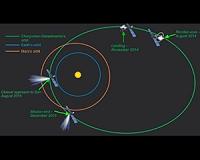
Paris, France (ESA) Sep 24, 2010 ESA's Rosetta mission needs to deliver its lander, Philae, to a site in the southern hemisphere of comet 67P/Churyumov-Gerasimenko, according to a new study of the comet's nucleus. "Southern sites appear to be both the safest and the most scientifically interesting," said Jeremie Lasue, who will be presenting the findings at the European Planetary Science Congress in Rome on Thursday 23rd ... read more |
|
|
| The content herein, unless otherwise known to be public domain, are Copyright 1995-2010 - SpaceDaily. AFP and UPI Wire Stories are copyright Agence France-Presse and United Press International. ESA Portal Reports are copyright European Space Agency. All NASA sourced material is public domain. Additional copyrights may apply in whole or part to other bona fide parties. Advertising does not imply endorsement,agreement or approval of any opinions, statements or information provided by SpaceDaily on any Web page published or hosted by SpaceDaily. Privacy Statement |


 del.icio.us
 Digg
Digg Reddit
 YahooMyWeb
 Google
 Facebook


