|
|
|
|
|
|
|
|
|
|
|


| . |  |
. |
|
|
|
 by Staff Writers Arecibo PR (SPX) Jan 07, 2013
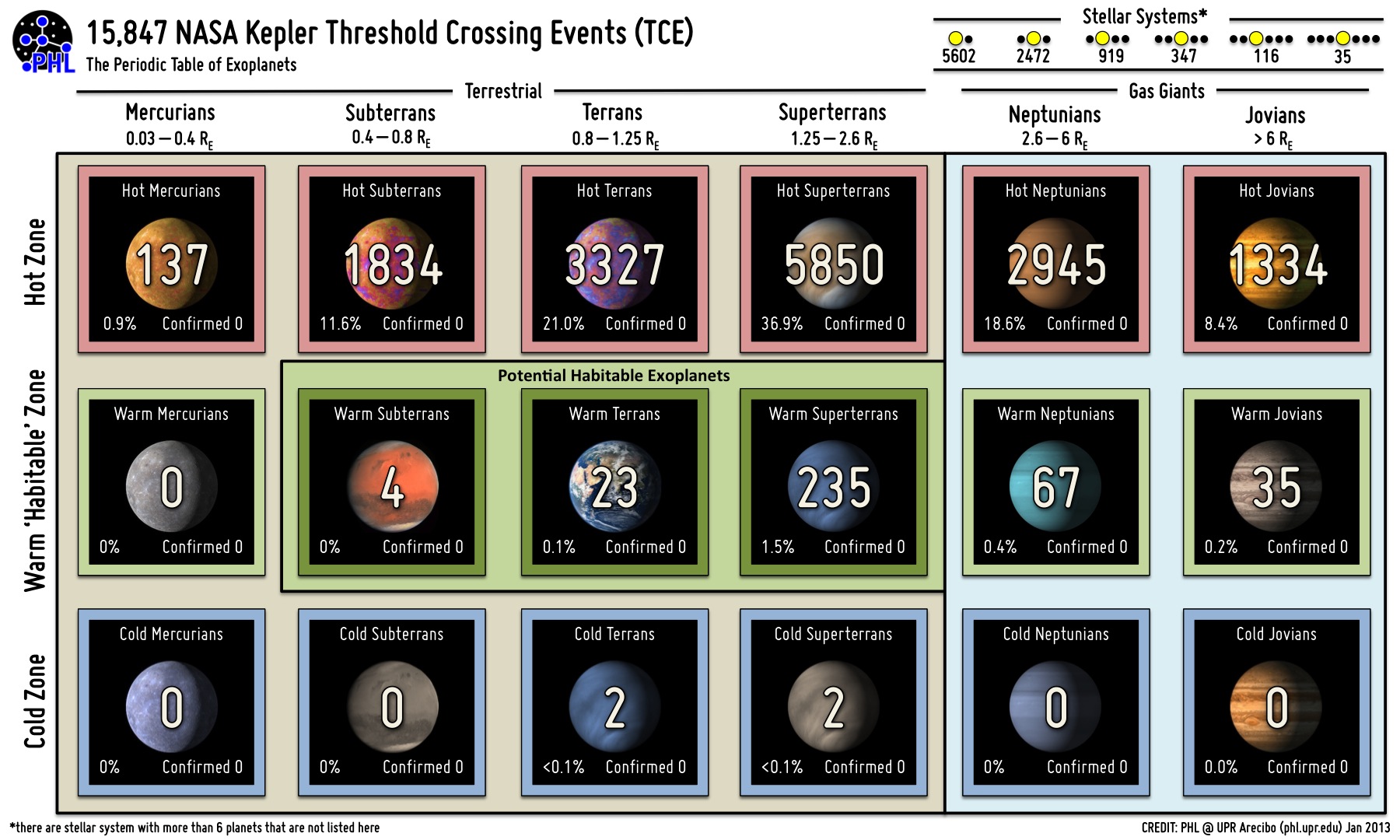
NASA Kepler released last month 18,406 planet-like detection events from its last three year mission to search for exoplanets (Kepler Q1-Q12 TCE). Further analysis is required by the NASA Kepler Team and the scientific community to extract and identify true planets, including those potentially habitable. The Planetary Habitability Laboratory @ UPR Arecibo (PHL) performed a preliminary analysis and identified 262 candidates for potentially habitable worlds in this dataset. These candidates become top priority for further analysis, additional observations, and confirmation. The Kepler Threshold Crossing Event (TCE) dataset consists of a list of stars with 18,406 transit-like features that resemble the signatures of transiting planets to a sufficient degree that they are passed on for further analysis. Many of these objects are false positives caused by stellar transits or other physical and instrumental conditions not related to planets. Those that pass additional tests are added to the Kepler Objects of Interest (KOI) list, currently at 2,320 candidates, for further validation. Finally, those verified by more astronomical observations supplement the 132 Kepler confirmed planets so far. Only the best TCE objects, those with more than three transit events, were selected for the analysis in accordance with the PHL's Habitable Exoplanet Catalog (HEC) criteria. This reduced the sample to 15,847 objects eliminating a known instrumental bias for one-year period planets. Unfortunately, this also eliminated many interesting objects but more analysis will be required to sort out longer period planets. HEC identified and sorted with the Earth Similarity Index (ESI), a measure of Earth-likeness, 262 potentially habitable planet candidates. These include four subterrans (Mars-size), 23 terrans (Earth-size), and 235 superterrans (super Earth-size). The preliminary analysis performed by the PHL helps to sort out and rank the best candidates for further exploration in NASA Kepler's TCE. Twenty-four of these have an ESI over 0.90 and therefore are quite Earth-like according to what is measurable. For example, the best candidate is an Earth-size planet in a 231 days orbit around the star KIC-6210395, which receives about 70% of the light that Earth receives from the Sun. More are expected with a similar period to Earth but they will be added later to HEC after further analysis. It will still be remarkable if only 50% of these turn out to be real planets. It is estimated that there are millions of Earth-like planets in our Galaxy. However, most of these are out of our observational abilities for the coming decades, and probably many centuries. Only a small fraction of these planets, the ones that transit their star, are good enough for better characterization and to confirm their potential for life. This result suggests that there are over 8,500 transiting very Earth-like planets within reach of NASA Kepler-like missions, assuming the Kepler field is representative of all the sky. This sample is enough to occupy astronomers for many years.
Related Links Planetary Habitability Laboratory Kepler Q1-Q12 TCE Habitable Exoplanets Catalog Lands Beyond Beyond - extra solar planets - news and science Life Beyond Earth
|
|
|
| The content herein, unless otherwise known to be public domain, are Copyright 1995-2014 - Space Media Network. AFP, UPI and IANS news wire stories are copyright Agence France-Presse, United Press International and Indo-Asia News Service. ESA Portal Reports are copyright European Space Agency. All NASA sourced material is public domain. Additional copyrights may apply in whole or part to other bona fide parties. Advertising does not imply endorsement,agreement or approval of any opinions, statements or information provided by Space Media Network on any Web page published or hosted by Space Media Network. Privacy Statement |

 del.icio.us
 Digg
Digg Reddit
 Google