
 |
 |
 |
 |
 |
 |
 |
 |
 |

 |

Washington DC (SPX) Oct 19, 2010 NASA selected 215 proposals for negotiation of Phase II contract awards in the Small Business Innovation Research program, or SBIR. The selected projects have a total value of approximately $129 million. NASA will award the contracts to 162 small high technology firms in 35 states. The SBIR program works with NASA's mission directorates to competitively select ventures that address research and technology needs for agency programs and projects. "Investing in small businesses innovations designed to meet our future mission needs is paramount for NASA's continued success," said Bobby Braun, NASA chief technologist at NASA Headquarters in Washington. "These awards will help small businesses across the country continue to employ and develop the high-tech workforce America needs for the future, while providing new knowledge and capabilities to NASA." Innovative research areas among the selected proposals include: + A sensor system for the detection and monitoring of clear air turbulence to help increase aviation safety + A process technology for converting carbon dioxide and methane for power co-generation and oxygen production + Large-format focal plane detectors capable of detecting ultraviolet to infrared radiation for use in future telescopes and NASA space missions + A software defined radio which supports reconfiguration, flexibility and increased performance and bandwidth that could be used for communications on the surface of Mars or the moon. The SBIR program is designed to address specific technology gaps in NASA missions while complementing other agency research investments. Program results have benefited numerous NASA efforts, including modern air traffic control systems, Earth observing spacecraft, the space shuttle and International Space Station, and the Mars rovers. The highly competitive SBIR program is a three-phase award system. It provides qualified small businesses with opportunities to propose unique ideas that meet specific research and development needs of the federal government. Phase I is a feasibility study to evaluate the scientific and technical merit of an idea. Awards are for as long as six months, in amounts up to $100,000. Phase II expands on the results of the developments in Phase I, providing awards for as long as two years in amounts up to $600,000. Phase III is for the commercialization of the results of Phase II and requires the use of private sector or non-SBIR federal funding. Participants submitted 340 Phase II proposals. The criteria used to select the winning proposals included technical merit and innovation, Phase 1 results, value to NASA, commercial potential and company capabilities. NASA's Ames Research Center at Moffett Field, Calif., manages the SBIR program for the agency's Office of the Chief Technologist. NASA collaborates with U.S. industry to develop pioneering technologies, infuse them into agency missions and transition them into commercially available products and services. NASA's 10 field centers manage individual projects. For a complete list of selected companies, visit: NASA Small Business Office
Share This Article With Planet Earth
Related Links NASA's Office of the Chief Technologist Space Tourism, Space Transport and Space Exploration News

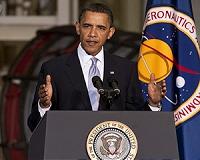 US President Obama's National Space Policy: New Analysis Available
Washington DC (SPX) Oct 04, 2010 Secure World Foundation is pleased to announce the availability of a new analysis of President Barack Obama's National Space Policy (NSP). The new NSP released in June is a White House directive that provides broad guidance on how the United States intends to conduct activities in outer space. This review - The 2010 Obama Space Policy: Sustainability, International Engagement and Sta ... read more |
|
|
| The content herein, unless otherwise known to be public domain, are Copyright 1995-2010 - SpaceDaily. AFP and UPI Wire Stories are copyright Agence France-Presse and United Press International. ESA Portal Reports are copyright European Space Agency. All NASA sourced material is public domain. Additional copyrights may apply in whole or part to other bona fide parties. Advertising does not imply endorsement,agreement or approval of any opinions, statements or information provided by SpaceDaily on any Web page published or hosted by SpaceDaily. Privacy Statement |


 del.icio.us
 Digg
Digg Reddit
 YahooMyWeb
 Google
 Facebook


