
 |
 |
 |
 |
 |
 |
 |
 |
 |

 |

Boston MA (SPX) May 10, 2011 As part of its Discovery Program, NASA has selected three potential missions for 2016 that would look at Mars' interior for the first time; study an extraterrestrial ocean on one of Saturn's moons; and study in unprecedented detail the surface of a comet's nucleus. Three technology developments for future planetary missions also were selected. Among them was Whipple, a mission proposed by the Harvard-Smithsonian Center for Astrophysics (CfA). "We look forward to developing and proving the technologies that will make Whipple successful in the next round of evaluation, and ultimately as a working mission," said Charles Alcock, CfA director and principal investigator of Whipple. The Whipple mission is designed to explore the most distant reaches of our solar system, where icy objects float in a perpetual deep-freeze. A dim Sun billions of miles away sheds little light on the residents of this region. As a result, they are difficult to detect directly against the inky blackness of interstellar space. Whipple will hunt for these hidden chunks of ice and dust by trying to spot their shadows. It will monitor tens of thousands of stars, watching for one of them to wink out when an otherwise unseen object slips in front of the star from the spacecraft's point of view. Whipple should be able to detect objects between half a mile and 6 miles across, orbiting the Sun at distances up to 2 trillion miles. (In comparison, Neptune orbits about 3 billion miles away - almost 1,000 times closer than some objects Whipple will find.) During the next several years, selected teams will receive funding to bring their respective technologies to a higher level of readiness. To be considered for flight, teams must demonstrate progress in a future mission proposal competition. Created in 1992, the Discovery Program sponsors frequent, cost-capped solar system exploration missions with highly focused scientific goals. NASA's Marshall Space Flight Center in Huntsville, Ala., manages the program for the agency's Science Mission Directorate.
Share This Article With Planet Earth
Related Links Discovery Program Space Tourism, Space Transport and Space Exploration News

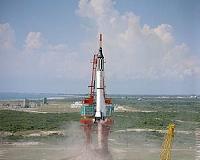 NASA, Space Community Remember 'Freedom 7'
Cape Canaveral FL (SPX) May 06, 2011 On the morning of May 5, 1961, astronaut Alan Shepard crawled into the cramped Mercury capsule, "Freedom 7," at Launch Complex 5 at Florida's Cape Canaveral Air Force Station. The slender, 82-foot-tall Mercury-Redstone rocket rose from the launch pad at 9:34 a.m. EST, sending Shepard on a remarkably successful, 15-minute suborbital flight. But more than that, it kick-started America's futu ... read more |
|
|
| The content herein, unless otherwise known to be public domain, are Copyright 1995-2010 - SpaceDaily. AFP and UPI Wire Stories are copyright Agence France-Presse and United Press International. ESA Portal Reports are copyright European Space Agency. All NASA sourced material is public domain. Additional copyrights may apply in whole or part to other bona fide parties. Advertising does not imply endorsement,agreement or approval of any opinions, statements or information provided by SpaceDaily on any Web page published or hosted by SpaceDaily. Privacy Statement |


 del.icio.us
 Digg
Digg Reddit
 YahooMyWeb
 Google
 Facebook


